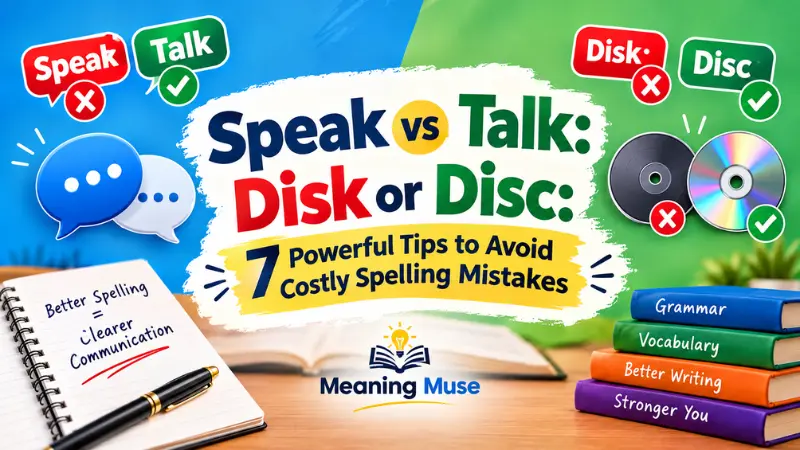
Disk or disc is a common spelling question because both forms are correct English words. The main difference is usually regional preference and context, not meaning.
For American English, disk is generally the safer choice, especially when talking about computer storage. Cambridge lists disk as the US form for a circular object and notes that British English commonly uses disc.
However, disc is also accepted in American English. It can appear when referring to a CD, DVD, musical recording, or certain physical and medical uses.
Knowing when to use each spelling can make your writing clearer and more natural.
Quick Answer
Disk or disc? Both are correct spellings.
For a US audience, choose disk in most general and computer-related writing:
- hard disk
- disk drive
- disk space
- magnetic disk
- computer disk
Use disc when it is the established spelling for a particular expression or when following a source’s preferred style.
In British English, disc is generally more common for the general sense of a flat, circular object, while disk is widely used in American English.
Why People Confuse Them
The confusion comes from the fact that disk and disc have the same pronunciation: /dɪsk/. They also share many of the same meanings.
For example, both can describe a flat, round object. Both can also refer to a device used for storing information.
The spelling difference is therefore easy to miss when you hear the word instead of seeing it.
Technology adds another layer of confusion. American English commonly uses expressions such as hard disk and disk space, while British English often uses hard disc or disc in some general contexts.
The important point is that the two spellings are not completely separate words.
Key Differences At A Glance
| Context | Best Choice | Why |
|---|---|---|
| American computer writing | disk | Common US preference |
| British general usage | disc | Common UK preference |
| Hard storage device | disk | Standard US expression |
| CD or DVD | disc is common | Often used for optical media |
| Flat circular object | disk or disc | Both are accepted |
| Medical context | disk or disc | Both forms occur |
Quick comparison:
- disk — preferred in much American English, especially computing
- disc — especially common in British English and in terms such as compact disc
Cambridge specifically identifies disk as the US spelling and disc as mainly British for the general circular-object sense.
Are They the Same Word?
Yes, in most cases disk and disc are spelling variants of the same lexical item.
Both can describe something flat and circular. They can also refer to a storage medium or a piece of cartilage in the body. Cambridge’s American Dictionary entry for disk lists disc as another spelling, while its disc entry describes it as another form of disk.
There can be differences in preferred usage depending on the subject.
For example, American computer terminology strongly favors disk:
The computer has a large hard disk.
For optical media, disc is also very familiar:
The movie was released on Blu-ray Disc.
So, context matters even though the spellings are closely related.
US vs UK Preference
The biggest practical difference is regional.
In American English, disk is generally preferred for the broad meaning and especially for computer storage. Cambridge gives examples such as hard disk, floppy disk, and disk space.
In British English, disc is often preferred when referring to a circular object. Cambridge labels disc as mainly UK and notes that US English usually uses disk.
This does not mean that Americans never use disc or that British writers never use disk. Both forms can appear in specialized contexts.
For US-focused writing, consistency is the best approach. If you are writing about computers, disk will usually sound more natural.
Which Spelling Should You Use?
If your audience is in the United States, disk is the best default choice.
Use disk for common computer expressions such as:
- hard disk
- disk drive
- disk space
- disk storage
- disk image
Choose disc when the specific expression or organization uses that form, particularly for optical media or when referring to a source that follows that spelling.
For example:
Natural US usage:
I need more disk space on my laptop.
Also accepted:
The album is available on disc.
The goal is not to treat one spelling as universally right and the other as wrong. Instead, choose the form that fits your audience and context.
When One Spelling Looks Wrong
Sometimes one spelling may look unusual even though it is technically acceptable.
An American reader is likely to expect:
hard disk
rather than:
hard disc
Likewise, compact disc is a very familiar expression, even though American dictionaries also recognize disk as a variant.
This is why spelling choice can depend on the fixed expression you are using.
A spelling can be grammatically acceptable but still feel less natural in a particular context. Good writing considers both correctness and common usage.
Common Mistakes (and Quick Fixes)
Mistake 1: Assuming “disc” is always wrong in US English
Fix: Both forms are accepted. Use disk as the normal US choice when there is no special reason to choose disc.
Mistake 2: Using “disc” automatically for every technology term
Fix: American computer terminology commonly uses disk, especially in expressions such as hard disk and disk space.
Mistake 3: Thinking the words have different pronunciations
Fix: Both are normally pronounced /dɪsk/.
Mistake 4: Changing spelling without considering the audience
Fix: For American readers, disk is usually the safest general choice.
Everyday Examples
Here are natural examples showing how the spellings work:
- My laptop has a 1-terabyte hard disk.
- The computer is running low on disk space.
- The old disk contained important files.
- She bought the movie on disc.
- The doctor examined the damaged disc in his back.
- The artist released a new music disc.
- The machine uses a magnetic disk for storage.
- The pastry was shaped into a thin disc.
These examples show why context matters. Disk is especially natural in American computer language, while disc remains common in other contexts.
Dictionary-Style Word Details
Verb
Neither disk nor disc is primarily needed as a verb for the spelling choice discussed here. Their most common uses in this comparison are nouns.
Noun
Disk is a noun meaning a flat, circular object or, especially in American English, a device or medium used for storing information.
Disc is also a noun for a flat, circular object. It can refer to a musical recording, CD, DVD, or a piece of cartilage in the body. Cambridge lists both US and UK usage patterns for these meanings.
Synonyms
There is no single perfect synonym for both spellings because the meaning changes with context.
Closest plain alternatives may include:
- circular object
- storage medium
- recording
- CD
- DVD
These alternatives should be used only when they accurately match the intended meaning.
Example Sentences
Disk:
The computer’s hard disk is almost full.
She saved the files to an external disk.
Disc:
The album is available on disc.
The doctor found a problem with a spinal disc.
Word History
The two spellings developed as variant forms of the same word. Modern English usage has retained both disk and disc, with regional and specialized preferences developing over time.
For present-day writers, the most useful distinction is not historical origin but current usage: disk is strongly established in American computing, while disc remains common in British English and in several familiar expressions.
Phrases Containing
Common phrases with disk include:
- hard disk
- disk drive
- disk space
- floppy disk
- magnetic disk
- disk storage
Common phrases with disc include:
- compact disc
- music disc
- optical disc
- disc drive
- spinal disc
FAQs
Is disk or disc correct in American English?
Both disk and disc are accepted in American English. However, disk is generally the preferred spelling for many general and computer-related uses.
Is disc British or American spelling?
Disc is especially common in British English, while American English generally prefers disk for the broad meaning of a circular object. Both forms can still occur in either variety.
Should I write hard disk or hard disc?
For American English, hard disk is the better choice. It is the standard form used in common US computer terminology.
Is compact disc spelled with disc?
Yes. Compact disc is the familiar expression for a CD. The spelling disc is especially well established in this expression.
Do disk and disc sound the same?
Yes. They are normally pronounced the same way: /dɪsk/.
Can I use disc in American English?
Yes. Disc is accepted in American English. However, disk is usually the safer choice for general US writing when there is no established reason to use disc.
Which spelling should I use for a US website?
Use disk as your default spelling, especially for computer storage. Use disc when it is part of a familiar expression or when the subject or source specifically uses that spelling.
Conclusion
So, disk or disc? Both spellings are correct, but disk is generally the better default for American English.
Use disk for common US computer terms such as hard disk, disk drive, and disk space. Use disc when the context or established expression calls for it, especially with terms such as compact disc.
The simplest rule is:
Writing for Americans? Choose “disk” by default.
Following a specific expression or source that uses “disc”? Keep “disc.”
The key is to understand the context rather than treating one spelling as always correct and the other as always wrong.
Suggested Internal Links
- Affect vs Effect →
/affect-vs-effect/ - Analyse vs Analyze →
/analyse-vs-analyze/ - As Well or Aswell →
/aswell-or-as-well/ - Amicable vs Amiable →
/amicable-vs-amiable/ - Brooch vs Broach →
/brooch-vs-broach/