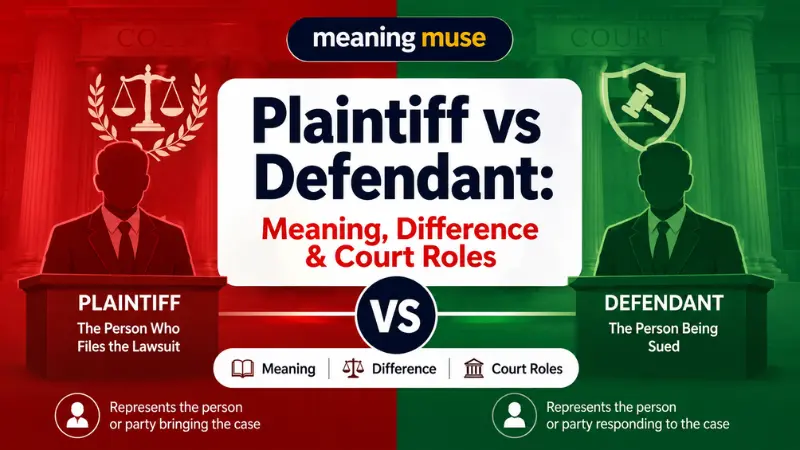
Plaintiff and defendant are two common words in court cases, but they describe opposite sides of a legal dispute.
In a civil lawsuit, the plaintiff is the person or organization that starts the case by filing a complaint. The defendant is the person or organization the plaintiff is suing.
For example, if Alex sues a company over damaged property, Alex is the plaintiff and the company is the defendant.
The word defendant is also used in criminal cases. In that setting, the defendant is the person accused of committing a crime.
Understanding plaintiff vs defendant is easier once you remember who starts the civil lawsuit and who must respond to it.
Quick Answer
The plaintiff starts a civil lawsuit. The defendant is the person or organization being sued.
In a criminal case, the accused person is also called the defendant, while the government brings the prosecution.
Simple rule:
Plaintiff = files the civil lawsuit.
Defendant = defends against the claim or criminal charge.
Example:
Maria sues ABC Company.
Maria = plaintiff
ABC Company = defendant
Plaintiff vs Defendant at a Glance
| Feature | Plaintiff | Defendant |
|---|---|---|
| Basic role | Starts a civil lawsuit | Is sued or accused |
| Civil case | Files the claim | Responds to the claim |
| Criminal case | Not normally the term for the prosecution | Person accused of a crime |
| Can be a person? | Yes | Yes |
| Can be a business? | Yes, in civil cases | Yes, in civil cases |
| Usually seeks relief? | Yes | Usually challenges or responds to the claim |
| Easy memory clue | Plaintiff brings the complaint | Defendant defends |
The biggest difference is simple:
The plaintiff brings the civil case.
The defendant responds to it.
What Is a Plaintiff?
A plaintiff is a person or legal entity that starts a civil lawsuit against another party.
The plaintiff normally begins the case by filing a complaint with a court.
The complaint explains what the plaintiff says happened, why the defendant may be legally responsible, and what relief the plaintiff is asking the court to provide.
A plaintiff may be:
- an individual
- a business
- an organization
- another legal entity
Simple Plaintiff Example
Suppose Sarah hires a contractor to repair her roof.
Sarah believes the contractor did not complete the work required by their agreement. She files a civil lawsuit seeking money for the loss.
Sarah is the plaintiff.
The contractor is the defendant.
What Does a Plaintiff Want?
A plaintiff asks the court for some form of legal relief.
Depending on the case, that might include:
- money damages
- enforcement of a legal right
- an order requiring someone to do something
- an order requiring someone to stop doing something
- another remedy allowed by law
The exact remedy depends on the type of case.
What Is a Defendant?
A defendant is the person or entity against whom a case is brought.
The word is used in both civil and criminal cases, but its meaning changes slightly with the type of case.
Defendant in a Civil Case
In a civil lawsuit, the defendant is the person or organization being sued by the plaintiff.
Example:
John sues XYZ Company for breach of contract.
John = plaintiff
XYZ Company = defendant
The defendant normally has an opportunity to respond to the plaintiff’s allegations and raise defenses.
Being named as a defendant does not automatically mean the person or company did something wrong. It means a legal claim has been made against that party.
Defendant in a Criminal Case
In a criminal case, the defendant is the person accused of committing a crime.
For example:
The government charges Daniel with a crime.
Daniel is the defendant.
A criminal defendant is accused, not automatically guilty. Guilt must be determined through the legal process, and the prosecution bears the burden required by criminal law.
What Is the Main Difference Between Plaintiff and Defendant?
The main difference is who brings the civil claim and who responds to it.
The plaintiff says:
“I am bringing this claim.”
The defendant says:
“I must respond to this claim.”
Consider this example:
Emma claims that a driver damaged her parked car and files a lawsuit.
Emma is the plaintiff because she started the civil case.
The driver is the defendant because the lawsuit was filed against that person.
Neither label tells you who will win.
“Plaintiff” and “defendant” describe the parties’ roles in the case, not the final result.
Plaintiff vs Defendant in a Civil Case
The plaintiff-defendant distinction is especially important in civil lawsuits.
A basic civil case often begins like this:
Step 1: The Plaintiff Files a Complaint
The plaintiff starts the lawsuit by filing the required court documents.
The complaint states the plaintiff’s claims.
Step 2: The Defendant Is Notified
The defendant is formally notified of the lawsuit according to the applicable court rules.
Step 3: The Defendant Responds
The defendant may file an answer or another permitted response.
An answer can admit or deny allegations and may raise defenses.
Step 4: Both Sides Present Their Positions
Depending on the case, the parties may exchange information, file motions, negotiate a settlement, or proceed toward trial.
Step 5: The Case Is Resolved
A civil case can end in several ways, including settlement, dismissal, judgment, or trial.
The plaintiff does not automatically win simply because the plaintiff filed first.
Plaintiff vs Defendant in a Criminal Case
This is where an important difference appears.
In standard U.S. legal usage, plaintiff is mainly a civil-law term.
A criminal case normally involves:
- Prosecution/government: brings the criminal charge
- Defendant: person accused of the crime
For example:
The United States brings a criminal case against Robert.
The government handles the prosecution.
Robert is the defendant.
You generally would not explain this situation by calling the victim the plaintiff.
The person harmed by an alleged crime may be called the victim, while the government prosecutes the criminal case.
A related civil lawsuit may have a plaintiff, but that would be a separate civil action.
Does Plaintiff Mean Victim?
No.
Plaintiff and victim are not synonyms.
A plaintiff is the party who starts a civil lawsuit.
A victim is someone who has suffered harm, especially in the context of a crime or harmful act.
Sometimes the same person may fit both descriptions, but not always.
For example, a person harmed by an alleged crime may be a victim in a criminal matter.
If that person later files a civil lawsuit seeking damages, the person may also become a plaintiff in that separate civil case.
The words describe different ideas.
Does Defendant Mean Guilty?
No.
This is one of the most important mistakes to avoid.
Defendant describes a person’s position in a case. It does not prove guilt or legal responsibility.
In a criminal case:
Defendant = accused person
It does not mean:
Defendant = guilty person
In a civil case, the same principle applies.
A company being sued is a defendant, but the court has not necessarily decided that the company is liable.
The label identifies the party defending against the claim.
Who Has the Burden of Proof?
The answer depends on the case and issue involved.
Civil Cases
A plaintiff generally has the burden of proving the claims the plaintiff brings.
The exact legal standard can depend on the type of claim.
A defendant may also have the burden of proving certain defenses or claims the defendant raises.
Criminal Cases
The government must prove the criminal charges against the defendant under the required criminal standard.
The defendant does not become responsible for proving innocence simply because charges were filed.
This is another reason the word defendant should never be treated as a synonym for “guilty.”
Can a Defendant Sue the Plaintiff?
Yes, a defendant may sometimes make a claim against the plaintiff.
This is commonly called a counterclaim.
Example:
Imagine Mia sues David over damage from a car accident.
Mia begins as the plaintiff.
David begins as the defendant.
David then claims that Mia actually caused damage to his car and makes a counterclaim.
David may be described as the counterclaimant, while Mia becomes the counterdefendant for that counterclaim.
This shows why court cases can become more complex than a simple two-sided label.
The original plaintiff and defendant roles can remain important even when additional claims are added.
Plaintiff vs Defendant in a Case Name
In a typical civil trial case, you may see a case written like:
Smith v. Jones
The v. means “versus.”
At the trial level, the party bringing the lawsuit is commonly listed first:
Smith = plaintiff
Jones = defendant
However, court cases can become more complicated on appeal, and terms such as appellant, appellee, petitioner, and respondent may become important.
For that reason, do not assume that every name appearing before or after “v.” always tells you the person’s current role at every stage of a case.
Plaintiff vs Defendant vs Petitioner
A petitioner is someone who files a petition asking a court for a particular action or ruling.
Some types of legal proceedings use:
petitioner vs respondent
instead of:
plaintiff vs defendant
For example, the word respondent is common in some appeals and other special proceedings.
The important point is that legal labels depend partly on the type and stage of the case.
Simple Comparison
Plaintiff: brings a civil lawsuit.
Defendant: is sued in a civil case or accused in a criminal case.
Petitioner: files a petition.
Respondent: responds to a petition or certain other proceedings.
These words are related, but they should not be treated as exact synonyms.
Plaintiff vs Defendant vs Prosecutor
A prosecutor is very different from a plaintiff.
A prosecutor is a government attorney who represents the government in a criminal case.
The prosecutor brings or handles the criminal case against the defendant on behalf of the government.
So:
Civil Case
Plaintiff vs Defendant
Example:
A customer sues a business.
Criminal Case
Government/Prosecution vs Defendant
Example:
The government prosecutes someone accused of a crime.
This distinction helps prevent one of the most common errors involving these legal terms.
Can a Business Be a Plaintiff or Defendant?
Yes.
In civil cases, plaintiffs and defendants are not limited to individual people.
A business may sue another party and become a plaintiff.
Example:
ABC Company sues XYZ Company over a contract dispute.
ABC Company = plaintiff
XYZ Company = defendant
A business can also be sued and become the defendant.
The same is true for many other organizations and legal entities.
How to Remember Plaintiff vs Defendant
Use two simple word clues.
Plaintiff = Person Who Files the Complaint
Think:
Plaintiff → files
The plaintiff files the civil lawsuit.
Both ideas point toward starting the case.
Defendant = Defends
This memory trick is even easier:
Defendant → defend
The defendant must respond to or defend against the claim or charge.
So remember:
Plaintiff = brings the civil claim.
Defendant = responds to the claim or charge.
Everyday Examples
Car Accident
Liam believes another driver caused an accident and files a civil lawsuit.
Liam: plaintiff
Other driver: defendant
Contract Dispute
A small business sues a supplier for allegedly breaking a contract.
Small business: plaintiff
Supplier: defendant
Property Dispute
A homeowner files a lawsuit against a contractor.
Homeowner: plaintiff
Contractor: defendant
Criminal Case
The government charges a person with robbery.
Government: prosecution
Accused person: defendant
There is normally no private plaintiff bringing that criminal prosecution.
Business Lawsuit
Company A sues Company B over an unpaid bill.
Company A: plaintiff
Company B: defendant
These examples show that the terms describe legal positions rather than particular types of people.
Common Mistakes and Quick Fixes
Mistake 1: Thinking the Plaintiff Is Always Right
A plaintiff makes a legal claim.
That does not mean the court has decided the claim is correct.
Fix: Think “person bringing the claim,” not “person who is right.”
Mistake 2: Thinking a Defendant Is Guilty
A defendant is the party facing a claim or criminal accusation.
Fix: Think “party responding,” not “guilty party.”
Mistake 3: Calling a Crime Victim the Plaintiff
In a criminal prosecution, the government brings the criminal case.
Fix: Use victim for the harmed person when appropriate and defendant for the accused person.
Mistake 4: Using Plaintiff for Every Type of Court Case
Some proceedings use petitioner and respondent instead.
Fix: Check what type of proceeding is involved.
Mistake 5: Assuming Only People Can Be Defendants
Businesses and other legal entities can also be plaintiffs or defendants in civil lawsuits.
Fix: Remember that either side may be a person or legal entity.
Pronunciation and Word Type
Both words are nouns.
Plaintiff: PLAIN-tif
Defendant: dih-FEN-duhnt
A person may also use these words before another noun in legal writing:
- plaintiff’s claim
- plaintiff’s attorney
- defendant’s response
- defendant’s attorney
The plural forms are:
plaintiffs
defendants
Example:
Several plaintiffs sued two defendants.
FAQs
What is the difference between plaintiff and defendant?
The plaintiff is the person or entity that starts a civil lawsuit. The defendant is the person or entity being sued. In a criminal case, the defendant is the person accused of the crime.
Who is the plaintiff in a court case?
In a civil lawsuit, the plaintiff is the party that files the case and asks the court for legal relief.
Who is the defendant in a lawsuit?
The defendant is the person, company, or other entity against whom the plaintiff brings the civil lawsuit.
Is the defendant always guilty?
No. Being called a defendant does not mean a person is guilty or legally responsible. It only describes that person’s role in the case.
Is there a plaintiff in a criminal case?
In standard U.S. terminology, plaintiff is mainly used for civil lawsuits. Criminal cases are brought by the government or prosecution against a defendant.
Can a company be a plaintiff?
Yes. A business or other legal entity can file a civil lawsuit and serve as the plaintiff.
Can a company be a defendant?
Yes. A company can be sued in a civil lawsuit and become the defendant.
Can the plaintiff become a defendant?
A defendant may bring a counterclaim against the plaintiff. For that counterclaim, the original defendant may be called the counterclaimant and the original plaintiff the counterdefendant.
What is a plaintiff in simple words?
A plaintiff is the person or organization that starts a civil lawsuit.
What is a defendant in simple words?
A defendant is the person or organization being sued, or in a criminal case, the person accused of a crime.
Conclusion
The difference between plaintiff vs defendant is easy to remember once you understand who brings the case.
In a civil lawsuit, the plaintiff starts the case by bringing a legal claim.
The defendant is the person or organization against whom that claim is made.
In a criminal case, the word defendant refers to the person accused of the crime, while the government handles the prosecution.
Most importantly, these labels do not tell you who is right, wrong, guilty, or innocent. They identify each party’s role in the legal process.
Remember the simple rule:
Plaintiff = files the civil claim.
Defendant = defends against the claim or charge.