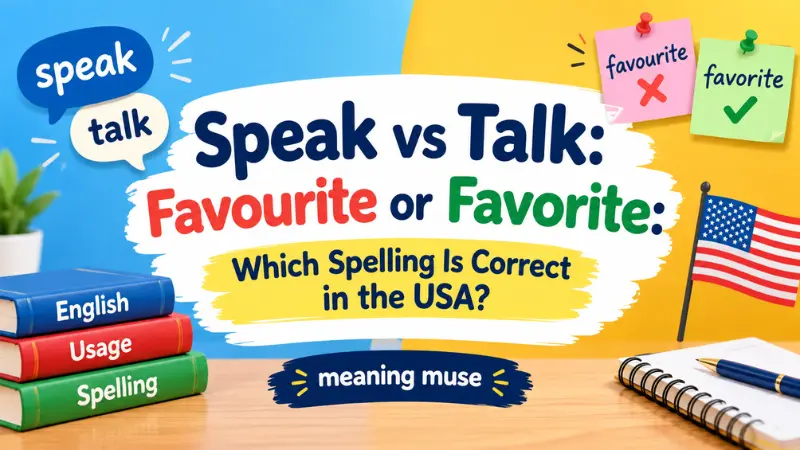
Favourite or favorite—which spelling should you use? If you are writing for a US audience, favorite is the standard American English spelling. Favourite, with a u, is the standard British English spelling.
Both words have the same meaning. They describe a person or thing you like more than others. For example, you might talk about your favorite movie, favorite food, or favorite book.
The main difference is regional spelling preference. Knowing which form to use will help you write clearly and consistently for your readers.
Quick Answer
Favorite is correct in American English, while favourite is standard in British English. Both spellings are accepted forms of the same word.
Examples:
- American English: Pizza is my favorite food.
- British English: Pizza is my favourite food.
The meaning does not change when you add the letter u. If your website, school, or business serves a US audience, choose favorite.
Why People Confuse Them
The words favorite and favourite look almost identical. The only spelling difference is the letter u.
Writers often see favourite in British books, international websites, and messages from people who use British English. American readers, on the other hand, are more familiar with favorite.
Both forms are correct within their usual spelling conventions. The confusion happens when writers assume that one spelling must be wrong everywhere.
The easiest way to remember the difference is to connect favorite with American English and favourite with British English.
Key Differences At A Glance
| Context | Best Choice | Why |
|---|---|---|
| US school assignment | Favorite | Standard American spelling |
| American business email | Favorite | Matches US writing conventions |
| US website or blog | Favorite | Consistent with an American audience |
| British English article | Favourite | Standard British spelling |
| International publication | Follow its style guide | Keeps spelling consistent |
Quick comparison:
- Favorite: Preferred American English spelling.
- Favourite: Preferred British English spelling.
- Meaning: The person or thing liked best.
- Pronunciation: Generally the same.
- Grammar: Both can function as a noun or an adjective.
Are They the Same Word?
Yes. Favorite and favourite are spelling variants of the same word. They share the same basic meaning and grammatical uses.
As an adjective, the word describes something you like best.
Example: This is my favorite book.
As a noun, it refers to the person or thing you like best.
Example: This book is my favorite.
The word can also describe a competitor expected to win a contest or sporting event.
Example: The home team is the favorite to win.
These uses remain the same when the word is spelled favourite. The spelling changes to fit the regional convention, but the meaning does not.
US vs UK Preference
American English uses favorite, without the u. British English uses favourite, with the u.
Here is how the difference appears in everyday writing:
- US English: My favorite color is blue.
- British English: My favourite colour is blue.
- US English: She is my favorite author.
- British English: She is my favourite author.
Notice that other words may also have different regional spellings. For example, American English commonly uses color, while British English uses colour.
For a US-focused article, use favorite throughout. If you are writing for a British audience, use favourite. Some other English varieties also use the British form, so consider the readers you want to reach.
Which Spelling Should You Use?
Choose favorite when writing for people in the United States. It is the natural choice for American schoolwork, business documents, websites, and everyday messages.
Use favourite when following British English spelling conventions or a publication’s preferred style.
Keep these three tips in mind:
- Know your audience. American readers generally expect favorite.
- Follow the style guide. A publisher or organization may specify a regional spelling convention.
- Stay consistent. Do not switch between favorite and favourite without a clear reason.
For a US-focused website, favorite is the best choice in headings, paragraphs, captions, and examples.
When One Spelling Looks Wrong
A familiar spelling can make the alternative look unusual. An American reader may notice the extra u in favourite, while a British reader may be more accustomed to seeing that letter.
However, an unfamiliar spelling is not automatically an incorrect one. Both forms are recognized English spellings.
The right choice depends on your audience and the style you follow. In standard American English, favorite is preferred. In standard British English, favourite is preferred.
Remember that spelling preference and spelling errors are not the same thing. A form can be correct in one regional variety even if another variety normally uses a different form.
Common Mistakes (and Quick Fixes)
Mistake 1: Thinking favourite is always wrong.
Quick fix: Recognize favourite as a standard British English spelling.
Mistake 2: Using both forms in the same article.
Quick fix: Choose one regional style and use it consistently.
Mistake 3: Assuming the words have different meanings.
Quick fix: Remember that both refer to a person or thing liked best, or a competitor expected to win.
Mistake 4: Forgetting the plural spelling.
Quick fix: Use favorites in American English and favourites in British English.
Mistake 5: Choosing a spelling without considering readers.
Quick fix: Use favorite for a US audience and favourite for a British audience.
Everyday Examples
Here are simple examples using the preferred American spelling.
Food and drinks
- Ice cream is my favorite dessert.
- Coffee is her favorite morning drink.
- Tacos are one of our favorite meals.
Books and entertainment
- That is my favorite book of the year.
- My favorite movie starts at seven.
- This song has always been a family favorite.
School and work
- Science is my favorite subject.
- This is my favorite project so far.
- The teacher asked us to name our favorite author.
Sports and competitions
- The team is the favorite to win the championship.
- She was the favorite in the final race.
- Many fans believe their favorite player will win.
Everyday conversations
- What is your favorite color?
- Which restaurant is your favorite?
- This is my favorite place to relax.
In British English, these sentences can use favourite and favourites instead. The meaning stays the same.
Dictionary-Style Word Details
Verb
In ordinary use, favorite and favourite are mainly used as nouns and adjectives. In computing, both can also be used as verbs to describe adding a website, image, or other item to a saved list.
- Favorite: Please favorite the page so you can find it later.
- Favourite: Please favourite the page so you can find it later.
The spelling follows the regional or platform convention. This verb use is especially associated with digital bookmarking and saved items.
Noun
- Favorite: A person or thing you like best, or a competitor expected to win. Example: This song is my favorite.
- Favourite: The same noun, spelled according to British English convention. Example: This song is my favourite.
The plural forms are favorites in American English and favourites in British English.
Synonyms
The closest plain alternatives depend on the sentence:
- Preferred: Liked or chosen over other options.
- Best-loved: Especially loved or liked.
- Choice: A person or thing selected or preferred.
- Pick: An informal word for a selected option.
These alternatives are not exact replacements in every sentence. For example, favorite can describe a competitor expected to win, while best-loved may not fit that context.
Example Sentences
- My favorite restaurant serves fresh pasta.
- This is her favorite song.
- He chose his favorite team to win.
- That little shop is a local favorite.
- The blue jacket is my favorite.
- Which book is your favorite?
In British English, the same sentences may use favourite. The word’s meaning and grammatical role remain unchanged.
Word History
The word favorite came into English through French and Italian, ultimately tracing back to the Latin word favor, meaning approval or goodwill.
The spellings favorite and favourite developed as regional forms. Modern American English generally omits the u, while British English retains it.
The spelling difference does not represent a difference in meaning. It reflects the conventions followed by different English-speaking communities.
Phrases Containing
Both spellings appear in the same types of phrases:
- favorite/favourite food
- favorite/favourite book
- favorite/favourite movie
- favorite/favourite color
- favorite/favourite song
- family favorite/family favourite
- all-time favorite/all-time favourite
- fan favorite/fan favourite
For American readers, use favorite food, favorite book, and all-time favorite. These forms fit standard US English.
FAQs
1. Is it favourite or favorite in American English?
Favorite is the correct spelling in American English. Favourite is the standard spelling in British English. Both words have the same meaning.
2. Is favourite or favorite the correct spelling?
Both spellings are correct, but they are used in different forms of English. Use favorite for American readers and favourite for British readers.
3. Why does American English use favorite instead of favourite?
American English often uses shorter spellings for certain words. It drops the extra “u” in words such as favorite, color, and honor.
4. Does favourite mean the same as favorite?
Yes. Favourite and favorite have the same meaning. Both describe something a person likes best or prefers over other choices.
5. How do you spell favorite in the USA?
In the United States, spell the word favorite, without the letter “u.” For example: “Pizza is my favorite food.”
6. Is favorite a noun or an adjective?
Favorite can be both a noun and an adjective. As a noun, it names something a person likes best. As an adjective, it describes something especially liked.
7. Should I use favourite or favorite in a school assignment?
Use favorite for a school assignment written in American English. If your teacher or school requires British English, use favourite instead.
8. What is the plural of favorite?
The plural of favorite is favorites in American English. In British English, the plural is usually favourites.
9. Is “my favourite movie” or “my favorite movie” correct?
Both are correct. Use “my favorite movie” in American English and “my favourite movie” in British English.
10. Which spelling should I use for a US website?
Use favorite if your website targets readers in the United States. Keep the spelling consistent across your pages to give readers a clear and professional experience.
Conclusion
When choosing between favourite or favorite, use favorite for standard American English and favourite for standard British English.
Both spellings have the same meaning and can function as nouns or adjectives. In digital contexts, they can also be used as verbs.
For a US-focused website, school assignment, or business document, favorite is the best choice. Keep your spelling consistent, and your writing w