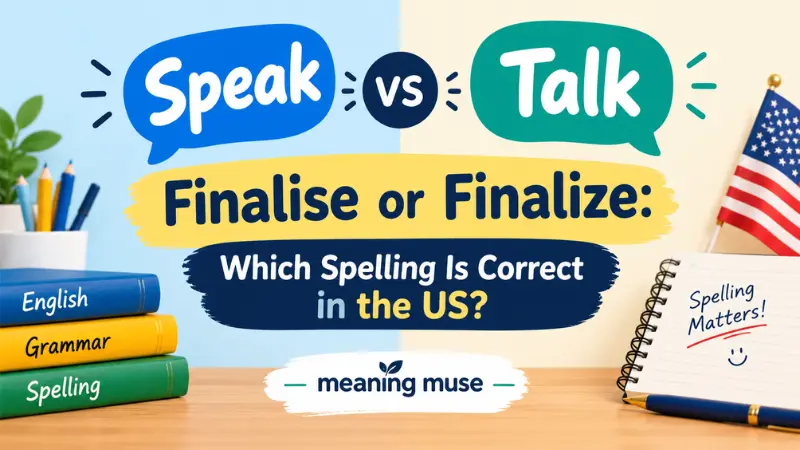
Finalise or finalize—which spelling should you use? If you are writing for a US audience, finalize is the standard American English spelling. Finalise is also a correct English spelling, commonly used in British English.
Both forms mean to complete something, settle the last details, or make a decision final. The difference is spelling preference, not meaning or grammar.
Whether you are writing an email, preparing a business report, or completing a project, choosing the spelling that fits your audience helps keep your writing clear and consistent.
Quick Answer
Finalize is the preferred spelling in American English. Finalise is commonly used in British English. Both spellings refer to the same verb and have the same meaning.
For example:
- US English: We need to finalize the contract today.
- British English: We need to finalise the contract today.
For American readers, choose finalize, finalized, and finalizing. Follow your organization’s spelling guide if it specifies a different convention.
Why People Confuse Them
The words finalise and finalize differ by just one letter. They sound the same in ordinary use and communicate the same idea.
The confusion comes from the spelling patterns used in different varieties of English. American English generally favors the -ize ending in this word, while British English commonly uses -ise.
Both spellings appear in published English, so seeing either form does not automatically mean the writer has made a mistake.
Writers may also encounter both forms when reading international websites, working with overseas clients, or editing documents written in different regional styles.
Key Differences At A Glance
| Context | Best Choice | Why |
|---|---|---|
| US business email | Finalize | Matches standard American spelling |
| US school assignment | Finalize | Fits American English conventions |
| US company report | Finalize | Keeps the document consistent |
| British English document | Finalise | Common British spelling preference |
| International document | Follow the chosen style | Consistency matters across the document |
The important point is simple: the spelling changes, but the meaning stays the same.
Quick comparison:
- Finalize: Preferred American English form.
- Finalise: Common British English form.
- Meaning: To complete the final details or make something final.
- Pronunciation: Generally the same.
- Grammar: Both function as verbs.
Are They the Same Word?
Yes. Finalise and finalize are spelling variants of the same verb. Neither spelling creates a separate meaning.
When you finalize a plan, you complete the remaining details or make the plan definite. When you finalise a plan, you express the same idea.
Consider these examples:
- We will finalize the meeting schedule after lunch.
- We will finalise the meeting schedule after lunch.
Both sentences communicate the same message. The choice depends on the spelling convention you are following.
The verb can be used with words such as plan, agreement, contract, report, schedule, and decision. It is useful when describing the last steps needed to complete an arrangement or project.
US vs UK Preference
American English generally uses finalize. British English commonly uses finalise, although the -ize form is also accepted in some British English references and publishing styles.
This means the regional distinction is a preference, not an absolute rule that makes the other spelling incorrect everywhere.
For US writing, these forms are the natural choices:
- finalize
- finalizes
- finalized
- finalizing
- finalization
In writing that follows a British -ise convention, the corresponding forms are:
- finalise
- finalises
- finalised
- finalising
- finalisation
The same pattern applies throughout the related word forms. Choose the set that matches your audience and apply it consistently.
Which Spelling Should You Use?
If your readers are in the United States, use finalize. It is the most suitable choice for American websites, business communication, reports, schoolwork, and everyday writing.
Use finalise when writing for a publication, employer, or audience that follows a British English spelling convention.
Here are three practical tips:
- Know your audience. Use finalize for standard US English.
- Follow your style guide. A company or publisher may have its own spelling rules.
- Stay consistent. Avoid switching between finalize and finalise without a clear reason.
For a US-focused article, the best choice is straightforward: write finalize throughout the main text and use finalise only when discussing the spelling difference.
When One Spelling Looks Wrong
A spelling may look unusual when it does not match the English variety you normally read.
For example, an American reader may expect finalize and pause when seeing finalise. A British reader who usually sees finalise may notice the z in finalize.
That reaction does not prove that either form is universally wrong.
The right way to judge the spelling is to consider the intended audience and the relevant style guide. In standard American English, finalize is the preferred choice. In British English, finalise is common, but finalize can also appear.
Do not treat a regional spelling preference as a grammar error.
Common Mistakes (and Quick Fixes)
Mistake 1: Assuming finalise is always incorrect.
Quick fix: Recognize finalise as a legitimate spelling used in British English.
Mistake 2: Using finalize and finalise randomly.
Quick fix: Select one regional convention and keep it consistent throughout the document.
Mistake 3: Thinking the two forms have different meanings.
Quick fix: Remember that both forms mean to complete or settle the final details.
Mistake 4: Changing only the base verb.
Quick fix: Keep related forms consistent. US writing normally uses finalized and finalizing, while a British -ise style commonly uses finalised and finalising.
Mistake 5: Assuming finalize is never used in Britain.
Quick fix: Avoid absolute claims. British English references and publishing styles do not all follow the same spelling convention.
Everyday Examples
Here are natural examples showing how finalize works in American English.
Business and work
- We need to finalize the contract before Friday.
- The manager will finalize the hiring plan tomorrow.
- Our team finalized the budget after reviewing the costs.
School and projects
- I want to finalize my science project this evening.
- The students finalized their presentation before class.
- We are finalizing the schedule for the school event.
Travel and personal plans
- Let’s finalize our vacation dates this weekend.
- She finalized the hotel reservation yesterday.
- They need to finalize the guest list before sending invitations.
Reports and decisions
- The editor will finalize the report this afternoon.
- The committee finalized its decision after the meeting.
- We are finalizing the last details of the launch.
The same sentences can use finalise when written in a style that prefers that spelling. The meaning does not change.
Dictionary-Style Word Details
Verb
- Finalize: To complete the remaining details of something or make it final. Example: We will finalize the agreement tomorrow.
- Finalise: The same verb with a spelling commonly used in British English. Example: We will finalise the agreement tomorrow.
Both forms can take an object, as in finalize the plan or finalise the report.
Noun
Neither finalise nor finalize is a noun; both are verbs.
The related noun forms are finalization in American English and finalisation in spelling conventions that use the corresponding -ise form. Both refer to the act or process of making something final.
Example: The finalization of the agreement took several days.
Synonyms
The closest plain alternatives depend on the sentence:
- Complete: To finish something.
- Settle: To resolve an issue or reach an agreement.
- Conclude: To bring a process or discussion to an end.
- Finish: To bring a task to completion.
These alternatives can often replace finalize, but they are not always interchangeable. Choose the word that best expresses the action you mean.
Example Sentences
- We need to finalize the report before the deadline.
- The team finalized the project plan on Monday.
- Please finalize your travel arrangements this week.
- The company will finalize the agreement after the review.
- We are finalizing the presentation for tomorrow’s meeting.
- The committee has finalized its recommendations.
In a British spelling style, the corresponding forms may be written as finalise, finalised, and finalising.
Word History
Finalize is formed from final and the suffix -ize. The spelling finalise represents an alternative form of the same verb.
The -ize ending is not exclusively American. Some British English dictionaries and publishing styles also accept it, while many British writers prefer -ise in words such as finalise.
The useful lesson is that the two forms reflect spelling conventions rather than different meanings.
Phrases Containing
Both forms appear in similar phrases:
- finalize/finalise a contract
- finalize/finalise an agreement
- finalize/finalise a report
- finalize/finalise a schedule
- finalize/finalise travel plans
- finalize/finalise the details
- finalize/finalise a decision
For US readers, use finalize a contract, finalize the details, and finalize the schedule. These phrases are clear and natural in American English.
FAQs
1. Is it finalise or finalize?
Finalize is the preferred spelling in American English. Finalise is commonly used in British English. Both spellings have the same meaning.
2. Is finalize correct in American English?
Yes. Finalize is the standard American English spelling. Use it in US business emails, reports, school assignments, and professional documents.
3. Is finalise a wrong spelling?
No. Finalise is a recognized spelling used in British English and other English-language contexts. It is not generally considered incorrect; the best choice depends on your audience and style guide.
4. Do finalise and finalize mean the same thing?
Yes. Both words mean to complete the last details of something or make it final. The difference is spelling preference, not meaning.
5. Should I use finalize or finalise in a business email?
For a business email written in American English, use finalize. For example: “We need to finalize the agreement by Friday.”
6. Is it finalized or finalised?
Finalized is the preferred American English spelling. Finalised is commonly used in British English. Both mean that something has been completed or made final.
7. Is it finalizing or finalising?
Use finalizing in American English. Finalising is common in British English. Both forms describe the process of completing the final details.
8. What is the noun form of finalize?
The noun is finalization in American English. Finalisation is used in spelling conventions that prefer finalise. Both refer to the process of making something final.
9. Is finalize used in British English?
Yes. Although finalise is common in British English, finalize is also accepted by some British dictionaries and style guides. Follow the spelling rules of your publication or organization.
10. What is the correct spelling in the USA: finalise or finalize?
Finalize is the preferred spelling in the United States. For consistent American English writing, use finalize, finalized, and finalizing.
Conclusion
When choosing between finalise or finalize, use finalize for standard American English. Use finalise when following a spelling convention that prefers the British -ise form.
Both spellings have the same meaning, grammatical role, and general pronunciation. The main difference is regional spelling preference.
For a US-focused website, business email, report, or school assignment, finalize is the best choice. Keep the spelling consistent, and