Prostrate and prostate look almost the same, but they are different words.
The extra r in prostrate changes the word completely.
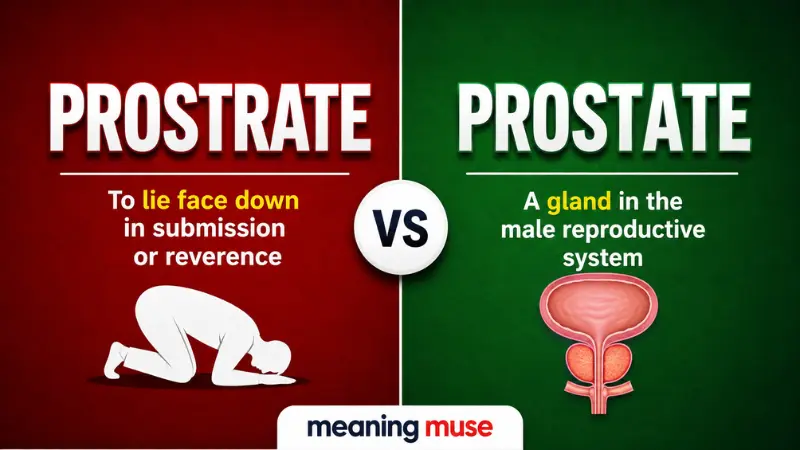
Prostrate usually means lying flat, often face down. It can also describe someone who is weak, exhausted, or overcome.
Prostate is mainly a medical word. It names a gland in the male reproductive system. The gland sits below the bladder and surrounds part of the urethra.
Because the spellings are so close, it is easy to mix them up. Their pronunciations are also similar.
This guide explains prostrate vs prostate in simple English. You will learn what each word means, how to pronounce it, when to use it, and how to remember the difference.
Quick Answer
Prostrate means lying flat, especially face down, or being very weak or overcome.
Prostate is a gland in the male reproductive system.
Example:
Correct: He lay prostrate on the ground.
Correct: The doctor examined his prostate.
They are not two spellings of the same word. They have different meanings and uses. Merriam-Webster lists prostrate as an adjective and verb, while prostate is primarily a noun and can also be used adjectivally in medical phrases.
Prostrate vs Prostate at a Glance
| Word | Main Meaning | Common Use | Simple Example |
|---|---|---|---|
| Prostrate | Lying flat or completely overcome | Body position, weakness, submission | He fell prostrate on the floor. |
| Prostate | A gland in the male reproductive system | Health and medical writing | The prostate is below the bladder. |
The easiest rule is simple:
Body position or extreme weakness = prostrate
Male reproductive gland = prostate
What Does Prostrate Mean?
Prostrate can be an adjective or a verb.
As an adjective, it can describe someone lying stretched out flat. It often suggests that the person is face down, weak, defeated, exhausted, or showing submission. Merriam-Webster also recognizes figurative uses for someone who is completely overcome or lacking strength.
For example:
“The exhausted runner was prostrate on the grass.”
Here, prostrate describes the runner’s position and condition.
Another example is:
“He lay prostrate before the king.”
In this sentence, the word suggests lying flat in a humble or submissive position.
Prostrate as a Verb
Prostrate can also be a verb.
To prostrate yourself means to place yourself flat on the ground, often as a sign of respect, worship, submission, or humility.
For example:
“The worshippers prostrated themselves in prayer.”
The verb can also mean to make someone very weak or powerless.
For example:
“The long illness prostrated him.”
That use is more formal and less common in everyday conversation.
What Does Prostate Mean?
Prostate has a very different meaning.
The prostate is a gland in the male reproductive system. It is located below the bladder and surrounds part of the urethra. It produces fluid that forms part of semen.
For example:
“The doctor checked his prostate.”
“The prostate can change as a person gets older.”
“Prostate cancer affects the prostate gland.”
In normal English, prostate is strongly connected with anatomy, medicine, and health.
You may also see it in phrases such as:
prostate gland
prostate cancer
prostate exam
prostate health
enlarged prostate
The National Cancer Institute also uses prostate for the gland and prostate cancer for cancer that forms in its tissues.
What Is the Main Difference Between Prostrate and Prostate?
The main difference is meaning.
Prostrate describes a position or condition.
Prostate names a body part.
Compare these two sentences:
“He was prostrate on the floor.”
“He had a prostate examination.”
In the first sentence, the writer is talking about how a person is lying.
In the second sentence, the writer is talking about a gland in the body.
The two words should not be swapped.
Writing “prostrate cancer,” for example, changes the intended word and is incorrect when you mean cancer of the prostate.
Likewise, writing “he was prostate on the floor” is incorrect when you mean that someone was lying flat.
Prostrate vs Prostate Pronunciation
The words sound similar, which is one reason they are often confused.
In American English, Cambridge gives prostrate roughly as:
PRAH-strayt
The middle of the word contains an str sound.
Prostate is roughly:
PRAH-stayt
It does not have that second r sound.
Think of the difference this way:
pro-STRATE
pro-STATE
Say the words slowly at first. The str sound in prostrate can help you remember the extra r.
Why Do People Confuse Prostrate and Prostate?
The main reason is their spelling.
Look at them side by side:
prostrate
prostate
Only one letter separates them.
Prostrate has an extra r after the t.
Their sounds are also close. In fast speech, the difference can be easy to miss.
There is another reason for the confusion. Prostate appears often in health information, while prostrate is less common in everyday speech. A writer may know how the medical word sounds but accidentally add an extra letter.
The reverse mistake can happen too.
Prostrate vs Prostate in a Sentence
Here are clear examples of prostrate:
“The man lay prostrate on the ground.”
“She found him prostrate with exhaustion.”
“The defeated soldier fell prostrate.”
“They prostrated themselves before the ruler.”
“The heat left several hikers prostrate with exhaustion.”
In each example, prostrate relates to lying down, submission, weakness, or being overcome.
Now compare examples of prostate:
“The prostate is part of the male reproductive system.”
“The doctor discussed prostate health with the patient.”
“He asked his doctor about an enlarged prostate.”
“The article explained how the prostate works.”
“Researchers study many conditions that affect the prostate.”
In these examples, prostate refers to the gland or describes something connected with it.
Common Mistakes With Prostrate and Prostate
A common mistake is writing:
Incorrect: He has prostrate cancer.
The correct form is:
Correct: He has prostate cancer.
The word prostate is needed because the sentence refers to the prostate gland.
Another common mistake is:
Incorrect: The tired athlete was prostate on the ground.
The correct sentence is:
Correct: The tired athlete was prostrate on the ground.
Here, prostrate describes the athlete’s position or condition.
Another example:
Incorrect: The doctor examined the prostrate.
Correct: The doctor examined the prostate.
Ask one question before choosing the word:
Am I talking about lying flat or being overcome, or am I talking about the body gland?
That usually gives you the answer right away.
Easy Trick to Remember Prostrate vs Prostate
Look for the extra r.
ProstRate has another r.
You can connect that r with the idea of being stretched across the ground.
Remember:
PROSTRATE = lying or stretched flat
PROSTATE = body gland
You can also use this short memory sentence:
A person can lie prostrate, but a person has a prostate.
That one sentence shows the difference clearly.
Is Prostrate the Same as Prone?
Not exactly.
Both words can describe lying down, but they do not always carry the same meaning.
Prone commonly means lying with the front of the body facing downward.
Prostrate can mean lying stretched out flat and may also suggest submission, defeat, worship, or exhaustion. Merriam-Webster makes this distinction in its comparison of prone, supine, and prostrate.
For example:
“The patient was placed in a prone position.”
“He fell prostrate before the altar.”
The words can overlap, but they are not always interchangeable.
Synonyms for Prostrate
Depending on the sentence, useful words close in meaning to prostrate include prone, recumbent, flat, exhausted, overcome, and helpless.
The exact choice depends on the meaning.
If you mean body position, prone or recumbent may sometimes fit.
If you mean weakness, exhausted, overcome, or powerless may fit better. Merriam-Webster lists prone, recumbent, and supine among words related to the lying-down sense of prostrate, while also noting important differences between them.
Prostate, however, does not have a normal everyday synonym because it is the specific name of an anatomical gland. Prostate gland is the fuller term.
Prostrate vs Prostate in Medical Writing
This pair can cause an especially noticeable error in health writing.
In medical contexts, prostate is usually the word you need when discussing the gland.
Common phrases include:
prostate gland
prostate cancer
prostate health
enlarged prostate
The word prostrate should not replace prostate in these phrases.
However, prostrate can still appear in medical or descriptive writing when a person’s position or physical condition is being described.
The meaning of the sentence should guide the choice.
Prostrate vs Prostate: Which Word Should You Use?
Use prostrate when you mean:
someone lying flat
someone lying face down
a person showing submission by lying down
someone completely exhausted or overcome
Use prostate when you mean:
the prostate gland
prostate health
prostate cancer
an enlarged prostate
something connected with the prostate gland
The words are not regional spelling choices. American and British English both keep the meanings separate.
FAQs
What is the difference between prostrate and prostate?
Prostrate means lying flat or being completely overcome or exhausted. Prostate is a gland in the male reproductive system. They are different words, not two spellings of one word.
Is it prostate or prostrate cancer?
The correct term is prostate cancer because the cancer forms in tissues of the prostate gland.
Does prostrate mean lying down?
Yes. Prostrate can describe someone stretched out flat, often with the face toward the ground. It may also suggest submission, defeat, or exhaustion.
Is prostate a body part?
Yes. The prostate is a gland in the male reproductive system. It sits below the bladder and surrounds part of the urethra.
How do you pronounce prostrate?
In American English, prostrate is commonly pronounced roughly PRAH-strayt. The str sound helps separate it from prostate.
How do you pronounce prostate?
In American English, prostate is commonly pronounced roughly PRAH-stayt.
Is prostrate a verb?
Yes. Prostrate can be a verb. For example, “They prostrated themselves.” It can also be an adjective, as in “He lay prostrate on the ground.”
What is an easy way to remember prostrate vs prostate?
Remember this sentence:
A person can lie prostrate, but a person has a prostate.
Also notice that prostrate has one extra r.
Conclusion
The difference between prostrate vs prostate becomes easy once you connect each word with its main meaning.
Prostrate is about lying flat, submission, weakness, or being completely overcome.
Prostate is the name of a gland in the male reproductive system.
They may look and sound similar, but they are not spelling variants.
For a quick reminder, use this rule:
Lie prostrate. Have a prostate.
That simple distinction will help you choose the correct word in everyday, academic, and medical writing.