Prideful and proud both come from the word pride, but they do not always sound the same.
Proud is the more flexible word. It can describe healthy happiness about an achievement, strong self-respect, or sometimes too much pride. Prideful also means full of pride, but it often suggests that someone is overly proud, arrogant, or unwilling to be humble.
For example, saying “I’m proud of my daughter” sounds warm and positive. Saying “He is too prideful to admit his mistake” sounds negative.
The easiest way to understand prideful vs proud is to look at the tone and meaning of the sentence.
Quick Answer
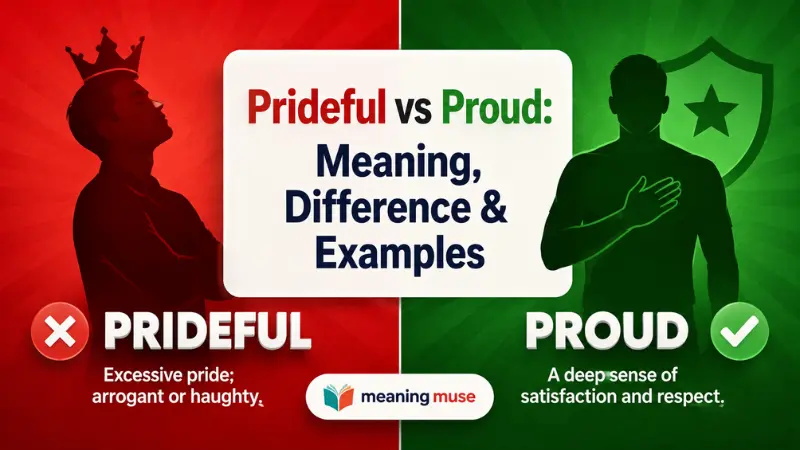
Proud usually means feeling pleased, satisfied, or honored because of an achievement, person, or quality. It can also describe someone who has too much pride.
Prideful means full of pride and often has a more negative tone, especially when it suggests arrogance, stubbornness, or an overly high opinion of oneself.
Examples:
- Proud: I’m proud of you for finishing school.
- Prideful: He was too prideful to ask for help.
Easy rule:
Healthy satisfaction → proud
Excessive or arrogant pride → often prideful
However, proud can also be negative when the context clearly shows excessive pride.
Prideful vs Proud at a Glance
| Feature | Proud | Prideful |
|---|---|---|
| Basic meaning | Feeling or showing pride | Full of pride |
| Positive use | Very common | Possible |
| Negative use | Also possible | Very common |
| Common positive idea | Happy about an achievement | Strong pride in something |
| Common negative idea | Too proud to apologize | Arrogant or overly self-important |
| Example | She is proud of her son. | He has a prideful attitude. |
| Best everyday choice for healthy pride | Usually proud | Less often needed |
The words overlap, but proud works naturally in a wider range of situations.
What Does Proud Mean?
Proud is an adjective that describes someone who feels pride.
That pride may be positive.
For example:
I’m proud of my grades.
The speaker feels happy and satisfied because of an achievement.
You can also be proud of someone else:
Her parents are proud of her.
This does not suggest arrogance. It simply means the parents feel pleased about what she has done.
Positive Meanings of Proud
Proud often describes:
- satisfaction
- achievement
- self-respect
- happiness for someone
- honor
- confidence in something worthwhile
Examples:
We are proud of our team.
She was proud to graduate from college.
I’m proud of the work we completed.
His family was proud of his progress.
In each sentence, proud has a positive or neutral meaning.
Can Proud Be Negative?
Yes.
Proud does not always mean healthy satisfaction.
It can also describe someone who thinks too highly of themselves or refuses to do something because of excessive pride.
For example:
He is too proud to admit that he was wrong.
Here, proud is negative.
The person’s pride prevents him from admitting a mistake.
Another example:
She was too proud to ask anyone for help.
Again, the word suggests that pride is creating a problem.
So the meaning of proud depends heavily on context.
Compare:
I’m proud of my son.
Positive.
He is too proud to apologize.
Negative.
The same adjective can express very different kinds of pride.
What Does Prideful Mean?
Prideful is also an adjective.
It literally describes someone or something that is full of pride.
In American English, the word often appears when pride has become excessive or unpleasant.
A prideful person may:
- think they are better than others
- refuse to admit mistakes
- dislike being corrected
- reject help because of ego
- act superior
- show too much self-importance
For example:
His prideful attitude made teamwork difficult.
The sentence suggests that his pride is a negative personality trait.
Another example:
She was too prideful to admit she needed help.
Again, the pride causes a problem.
Can Prideful Be Positive?
Yes.
This is an important point.
Prideful is not always negative.
It can sometimes describe someone who feels happy or satisfied about something.
For example:
She feels prideful about her hometown.
The intended meaning may simply be that she feels strong pride in where she comes from.
However, when you only want to express normal, healthy satisfaction, proud is usually the clearer and more familiar choice.
Compare:
I’m proud of my school.
This sounds simple and natural.
I’m prideful about my school.
This can also express pride, but the word prideful may make some readers think of excessive pride because of its common negative use.
For clear everyday writing, proud is usually safer when no criticism is intended.
What Is the Main Difference Between Prideful and Proud?
The main difference is tone and range of meaning.
Proud has a broad range.
It can mean:
- happily satisfied
- honored
- confident
- self-respecting
- overly proud or arrogant
Prideful also describes pride, but it often draws more attention to having a lot of pride, especially when that pride becomes a character flaw.
Compare:
Maya was proud of winning the award.
This sounds positive.
Maya became prideful after winning several awards.
This suggests that her success may have made her too full of herself.
The second sentence does more than say Maya feels happy.
It suggests a change in attitude.
Which Word Should You Use?
Use proud when you mean normal satisfaction, happiness, or self-respect.
Examples:
I’m proud of you.
She is proud of her children.
We are proud of our work.
He was proud to represent his school.
Use prideful when you want to emphasize excessive pride, arrogance, or stubborn self-importance.
Examples:
His prideful behavior upset the team.
She became prideful after her success.
He was too prideful to admit his mistake.
A prideful attitude can make criticism hard to accept.
When the meaning is positive, proud will usually communicate your idea more clearly.
Proud Of vs Prideful About
A very common pattern in English is:
proud of + person, thing, or achievement
Examples:
I’m proud of my sister.
She is proud of her grades.
They are proud of their community.
Another common structure is:
proud to + verb
Examples:
I’m proud to be part of this team.
She was proud to help.
We are proud to support the project.
With prideful, you may see expressions such as:
prideful about
Example:
He was prideful about his accomplishments.
However, if you simply mean pleased or satisfied, proud of is generally the clearer everyday construction.
Prideful vs Proud in Positive Situations
Suppose your child wins a school award.
You would normally say:
I’m proud of my child.
That clearly communicates happiness and support.
Now imagine someone wins an award and begins acting as if everyone else is less talented.
You might say:
He became prideful after winning the award.
Here, prideful helps show that the person’s pride has become excessive.
The situation may begin with healthy pride but develop into unhealthy pride.
That difference explains why the two adjectives can overlap without always feeling interchangeable.
Prideful vs Proud in Negative Situations
Both words can describe negative pride.
Consider:
He is too proud to apologize.
and:
He is too prideful to apologize.
Both sentences can mean that excessive pride prevents him from saying sorry.
However, prideful places strong attention on pride as a negative trait.
Proud depends more on the rest of the sentence—especially words such as too—to create the negative meaning.
Compare:
She is proud.
Without more context, this could easily sound positive.
She is prideful.
This is more likely to be understood as criticism.
Context still matters, but the tone is different.
Proud vs Prideful Examples
Use Proud for Healthy Satisfaction
I’m proud of how hard you worked.
The speaker is pleased with someone’s effort.
Her parents were proud of her graduation.
The parents feel happy about her achievement.
We are proud of our community.
The sentence expresses positive group pride.
He was proud to serve as team captain.
He feels honored by the role.
You should be proud of yourself.
The speaker encourages healthy satisfaction.
Use Prideful for Excessive Pride
His prideful attitude stopped him from listening.
His pride causes a problem.
She became prideful after receiving so much praise.
The praise may have made her overly self-important.
He was too prideful to accept advice.
His ego keeps him from accepting guidance.
The prideful manager rarely admitted mistakes.
The word describes an undesirable personality trait.
Her prideful response made the disagreement worse.
Her excessive pride contributed to the conflict.
Prideful vs Arrogant
Prideful and arrogant can overlap, but they are not always perfect replacements.
Arrogant clearly describes someone who acts as though they are better or more important than others.
Example:
His arrogant tone annoyed everyone.
Prideful focuses on being full of pride, which may lead to arrogant behavior.
Example:
He was too prideful to admit that his coworker had the better idea.
So a prideful person may act arrogantly, but the words focus on slightly different ideas.
For simple writing:
arrogant → acting superior
prideful → having excessive pride
Proud vs Confident
Being proud is also different from being confident.
Confident means believing in your abilities or expecting that you can succeed.
Proud means feeling satisfaction about yourself, another person, or something connected to you.
Example:
She was confident before the test.
She believed she could do well.
After receiving a high score:
She was proud of her result.
Now she feels satisfaction about what she achieved.
Confidence often comes before or during an action.
Pride often follows something you value or accomplish.
Prideful vs Proud in American English
Both words are used in American English.
Proud appears naturally in a wide range of everyday expressions:
- proud parent
- proud moment
- proud of you
- proud of myself
- proud to serve
- proud tradition
- proud achievement
Prideful is more focused.
You may see it in expressions such as:
- prideful attitude
- prideful person
- prideful behavior
- prideful response
- prideful thinking
- too prideful to apologize
This difference in common contexts is useful.
If you are describing a happy parent, student, worker, athlete, or family member, proud is usually the natural choice.
If you are describing ego or excessive self-importance, prideful may express the idea more clearly.
Are Prideful and Proud Synonyms?
They can be synonyms in some contexts because both describe pride.
However, they are not interchangeable in every sentence.
Consider:
I’m proud of you.
Replacing proud with prideful would change the natural tone:
I’m prideful about you.
That does not communicate the same warm, ordinary meaning as clearly.
Now consider:
He is a prideful man who refuses criticism.
Here, proud could also work, but prideful puts stronger emphasis on excessive pride.
So the words overlap, but their tone and common usage differ.
Grammar and Word Forms
Both proud and prideful are adjectives.
Proud
Pronunciation: PROWD
Examples:
a proud parent
a proud student
She feels proud.
I am proud of you.
Related forms include:
- proudly
- prouder
- proudest
Examples:
She proudly displayed her certificate.
I could not be prouder of you.
Prideful
Pronunciation: PRIDE-fuhl
Examples:
a prideful attitude
a prideful response
He became prideful.
Related forms include:
- pridefully
- pridefulness
Example:
His pridefulness made it difficult for him to accept criticism.
Common Mistakes
Mistake 1: Thinking Proud Is Always Positive
It is not.
He was too proud to admit the truth.
Here, proud clearly has a negative meaning.
Fix: Check the full sentence and context.
Mistake 2: Thinking Prideful Is Always Negative
Prideful often sounds negative, but dictionaries also recognize positive uses related to feeling pride or satisfaction.
Fix: Do not treat the negative meaning as an absolute rule.
Mistake 3: Using Prideful When Proud Is Simpler
For ordinary positive feelings, proud usually sounds clearer.
Better:
I’m proud of my daughter.
Less natural for this simple idea:
I’m prideful about my daughter.
Mistake 4: Treating Proud and Arrogant as Exact Synonyms
Proud can describe healthy satisfaction.
Arrogant is clearly negative.
Fix: Look at whether the pride is reasonable or excessive.
Mistake 5: Assuming Prideful and Proud Are Different Spellings
They are not spelling variants.
They are separate adjectives formed from the same idea of pride.
Their meanings overlap, but their tone and usage are different.
Easy Memory Trick
Remember:
Proud = Pleased
Both start with P.
Think:
Proud → pleased with something
Example:
She is proud of her grades.
Prideful = Full of Pride
The ending -ful means “full of.”
So:
Pride + ful = full of pride
That can help explain why prideful often sounds stronger and may suggest too much pride.
Use this simple rule:
Happy about an achievement → proud
Too full of pride → prideful
FAQs
What is the difference between prideful and proud?
Proud can describe healthy satisfaction, self-respect, or excessive pride. Prideful also means full of pride but often has a more negative tone and may suggest arrogance or excessive self-importance.
Is prideful a real word?
Yes. Prideful is a standard English adjective meaning full of pride. It can have both positive and negative meanings, although its negative, disapproving sense is common.
Is it better to say proud or prideful?
Use proud for normal satisfaction or happiness about an achievement. Use prideful when you want to emphasize excessive pride, arrogance, or a strongly pride-driven attitude.
Is prideful always negative?
No. Prideful can sometimes describe positive satisfaction or pride. However, it often carries a negative tone, especially when describing someone as haughty, smug, or overly self-important.
Can proud be negative?
Yes. For example, “He is too proud to apologize” describes excessive pride and has a negative meaning.
Is being proud the same as being arrogant?
No. Healthy pride can mean feeling pleased about a real achievement. Arrogance means having or showing an exaggerated sense of superiority.
Should I say proud of or prideful of?
For normal everyday satisfaction, proud of is the standard and clearer choice.
Example:
I’m proud of my family.
What does prideful mean in simple words?
Prideful means full of pride. It often describes someone whose pride is excessive and makes them seem arrogant, stubborn, or unwilling to admit mistakes.
What does proud mean in simple words?
Proud means feeling pleased or satisfied about yourself, another person, or something you value. It can also describe excessive pride in negative contexts.
How can I remember prideful vs proud?
Remember:
Proud = pleased.
Prideful = full of pride.
For positive everyday feelings, choose proud. For excessive pride, prideful is often the clearer word.
Conclusion
The difference between prideful vs proud is mainly about meaning and tone.
Use proud when someone feels healthy satisfaction, happiness, honor, or self-respect.
I’m proud of you.
Use prideful when you want to emphasize being full of pride, especially when that pride becomes excessive, stubborn, or arrogant.
He was too prideful to admit his mistake.
Remember that the difference is not absolute. Proud can also be negative, and prideful can sometimes be positive.
For most everyday positive situations, however, the simplest choice is:
Healthy pride → proud
Excessive pride → often prideful