esponse and respond are closely related, but they do different jobs in a sentence.
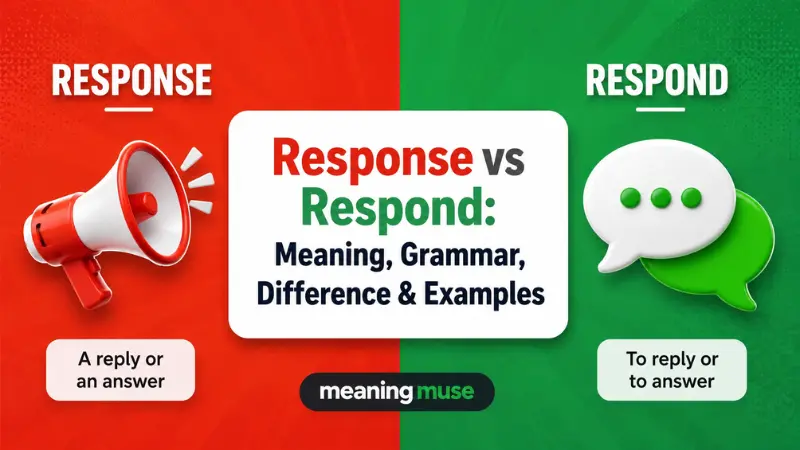
Response is usually a noun. It means an answer, reply, or reaction.
Respond is usually a verb. It means to answer or react.
For example:
“I sent a response to her email.”
“I responded to her email.”
The meaning is similar, but the grammar is different.
Here is the easiest rule:
Response = the answer or reaction.
Respond = the action of answering or reacting.
If you remember thing vs action, choosing between response and respond becomes much easier.
Quick Answer
The main difference between response vs respond is their part of speech.
Response is a noun.
Respond is a verb.
Use response when you are naming the answer or reaction:
“I received a response.”
Use respond when someone performs the action:
“Please respond today.”
A simple memory trick is:
You RESPOND by giving a RESPONSE.
That one sentence shows how the two words work together.
What Does Response Mean?
Response is mainly a noun.
It means something said, written, felt, or done as an answer or reaction to something.
For example:
“Thank you for your response.”
Here, response is the answer that someone gave.
Another example:
“Her response surprised me.”
The sentence talks about her reaction as a thing.
Other simple examples include:
“We are waiting for his response.”
“She gave a quick response.”
“The company received a positive response.”
“I had no response from the teacher.”
“His first response was to laugh.”
In each sentence, response names an answer or reaction.
Simple Meaning of Response
Think of response as:
an answer
a reply
a reaction
It is something that a person gives, sends, receives, gets, hears, or sees.
That is why these phrases sound natural:
“give a response”
“send a response”
“receive a response”
“wait for a response”
“get a response”
What Does Respond Mean?
Respond is mainly a verb.
It means to answer or react to someone or something.
For example:
“Please respond to my email.”
Here, respond describes an action.
Another example:
“She responded quickly.”
She performed the action of answering.
You can also respond through an action rather than words.
For example:
“He responded to the alarm by leaving the building.”
The person reacted to the alarm.
Other examples include:
“Did she respond?”
“He responded to my question.”
“The students responded well to the lesson.”
“She responded with a smile.”
“The doctor said the patient was responding to treatment.”
The exact reaction can change, but respond still describes what someone or something does.
Simple Meaning of Respond
Think of respond as:
to answer
or
to react
If the sentence needs an action word, respond is often the correct choice.
Response vs Respond at a Glance
| Context | Best Choice | Why |
|---|---|---|
| Naming an answer | Response | It is a noun |
| Asking someone to answer | Respond | It is a verb |
| Talking about a reaction | Response | The reaction is being named |
| Describing the act of reacting | Respond | It describes an action |
| “Thank you for your ___” | Response | A noun is needed |
| “Please ___ soon” | Respond | A verb is needed |
| “In ___ to your email” | Response | “In response to” is the standard phrase |
| “She ___ to my email” | Responded | The sentence needs a verb |
Here is another quick comparison:
- Response: noun
- Respond: verb
- Response: an answer
- Respond: to answer
- Response: a reaction
- Respond: to react
- Response: “I got a response.”
- Respond: “She responded.”
Why People Confuse Response and Respond
The words are easy to confuse because they belong to the same word family.
Look at them:
response
respond
They have similar spellings.
They also share closely related meanings.
A response is often what you get when someone responds.
For example:
“I asked a question.”
“She responded.”
“Her response was helpful.”
The second and third sentences describe the same communication from two grammatical angles.
Responded tells us what she did.
Response names what she gave.
The final letters provide a useful clue:
response → noun
respond → verb
Are Response and Respond the Same Word?
No.
They are closely related words, but they are not interchangeable.
They have different grammatical roles in normal English.
Compare:
Correct: “I need your response.”
Incorrect: “I need your respond.”
The word after your needs to function as a noun, so response is correct.
Now compare:
Correct: “Please respond to me.”
Incorrect: “Please response to me.”
After please, the sentence needs a verb describing what the person should do. Therefore, respond is correct.
This is the central rule behind response vs respond.
Ask:
Do I need a thing or an action?
If you need a thing, answer, or reaction, choose response.
If you need the action of answering or reacting, choose respond.
How to Use Response Correctly
The word response appears in several common sentence patterns.
Response to
Use response to when naming an answer or reaction to something.
Examples:
“Her response to the question was clear.”
“We received no response to our request.”
“His response to the news was surprising.”
“The public response to the event was positive.”
The pattern is:
response + to + something
Response From
Use response from when you want to say who gave the answer.
Examples:
“I received a response from my manager.”
“We have not received a response from the school.”
“Her response came from the support team.”
In Response To
In response to means as an answer or reaction to something.
Examples:
“I am writing in response to your email.”
“The company changed its policy in response to customer complaints.”
“She smiled in response to his joke.”
This is a very common phrase in emails, school writing, work messages, and formal communication.
Give a Response
You can also say:
“Please give me a response.”
“She gave a short response.”
“He gave no response.”
However, in many simple sentences, using respond can sound shorter and more natural.
Compare:
“Please give me a response.”
“Please respond.”
Both can work, but the second is more direct.
How to Use Respond Correctly
Respond often appears with to.
Respond To
Examples:
“Please respond to my question.”
“She responded to the email.”
“How did he respond to the news?”
“The firefighters responded to the emergency.”
The pattern is:
respond + to + person, message, event, question, or situation
Do not normally use:
“respond the email”
Instead, write:
“respond to the email”
Respond With
Use respond with when explaining what answer or reaction someone gave.
Examples:
“She responded with a smile.”
“He responded with a short message.”
“The audience responded with applause.”
Respond By
Use respond by when explaining the action taken as a reaction.
Examples:
“The company responded by changing the policy.”
“She responded by walking away.”
“He responded by asking another question.”
Respond That
In more formal writing, respond can introduce what someone said.
For example:
“She responded that she was unavailable.”
In everyday speech, said, replied, or another simple verb may sometimes sound more natural.
Response or Respond: Which One Should You Use?
Try this simple test.
Can You Put “A” Before It?
If you can naturally place a before the word, you probably need response.
“A response”
Correct.
“A respond”
Not correct in the normal answer-or-reaction meaning.
For example:
“I need ___ today.”
Try:
“I need a response today.”
That works.
So choose response.
Can You Put “Please” Before It?
If the word describes what someone should do, you probably need respond.
“Please respond.”
Correct.
“Please response.”
Incorrect.
For example:
“Please ___ before Friday.”
Correct:
“Please respond before Friday.”
Thing or Action Test
Ask:
Am I naming the answer?
Use response.
Am I describing the act of answering?
Use respond.
This test works in most everyday situations.
Common Mistakes With Response and Respond
Mistake 1: “Please Response”
Incorrect: “Please response to my email.”
Correct: “Please respond to my email.”
Why?
After please, you need an action verb.
Respond is the verb.
Mistake 2: “I Need Your Respond”
Incorrect: “I need your respond.”
Correct: “I need your response.”
The word comes after your and names the answer you need.
That requires the noun response.
Mistake 3: “Thank You for Your Respond”
Incorrect: “Thank you for your respond.”
Correct: “Thank you for your response.”
Again, the sentence needs the noun.
A very common professional phrase is:
“Thank you for your response.”
Mistake 4: “He Response Quickly”
Incorrect: “He response quickly.”
Correct: “He responds quickly.”
Or, in the past:
“He responded quickly.”
The sentence describes what he does, so you need the verb respond.
Mistake 5: “She Respond to Me Yesterday”
Incorrect: “She respond to me yesterday.”
Correct: “She responded to me yesterday.”
Because the action happened yesterday, the past tense responded is needed.
Mistake 6: Confusing “Response To” and “Respond To”
Both forms can use to, but the grammar changes.
Response to:
“His response to the question was correct.”
Respond to:
“He responded to the question.”
One names the answer.
The other describes the action.
Easy Trick to Remember Response vs Respond
Use this short sentence:
You respond by giving a response.
Break it down:
respond = do
response = thing
Another memory trick is to connect the endings.
Respond works like other action words:
“respond”
“responds”
“responded”
“responding”
Response works like a noun:
“a response”
“the response”
“your response”
“several responses”
If you can make the word plural as responses, you are using the noun.
Everyday Examples
Here are examples with response:
“Thank you for your quick response.”
“I am still waiting for a response.”
“His response made everyone laugh.”
“We received a positive response.”
“She wrote a response to the complaint.”
“There was no response when I knocked.”
“The teacher liked my response.”
“Her first response was no.”
Now compare examples with respond:
“Please respond when you have time.”
“She responded to my message.”
“He did not respond.”
“How should I respond?”
“They responded quickly.”
“The dog responded to its name.”
“She responded with a question.”
“He responded by sending another email.”
Now look at the words together:
“I asked him to respond, but I never received a response.”
“She responded quickly, and her response answered my question.”
“Please respond today so we can record your response.”
These examples show the noun-and-verb relationship clearly.
Dictionary-Style Word Details
Verb
Response: In ordinary modern English, response is not used as the verb meaning “to answer.” Use respond instead.
Incorrect:
“Please response today.”
Correct:
“Please respond today.”
Respond: Mainly a verb meaning to answer or react.
Common forms are:
respond
responds
responded
responding
Examples:
“I will respond tomorrow.”
“She responds quickly.”
“He responded yesterday.”
“They are responding now.”
Noun
Response: A noun meaning an answer, reply, or reaction.
Examples:
“a response”
“your response”
“her response”
“three responses”
“no response”
Respond: In normal everyday communication, respond is used as a verb rather than the noun for an answer.
There is a rare specialized noun use of respond in architecture, but it is unrelated to the common choice between response and respond when talking about answers and reactions.
For everyday English, use response for the noun.
Synonyms
Close alternatives for response include:
answer
reply
reaction
The best choice depends on context.
For example, reaction can describe feelings or behavior, while answer often relates directly to a question.
Close alternatives for respond include:
answer
reply
react
Again, they do not work exactly the same way in every sentence.
Compare:
“She responded to the question.”
“She answered the question.”
Both can work.
But:
“The medicine responded well”
does not make sense in the same way as:
“The patient responded well to the medicine.”
Always check the complete meaning of the sentence.
Example Sentences
Response:
“We are waiting for your response.”
“His response was polite.”
“I received a response this morning.”
“Her response to the news was calm.”
Respond:
“Please respond as soon as you can.”
“She responded politely.”
“He responded to every question.”
“They did not respond immediately.”
Word History
Response and respond belong to the same historical word family.
Their shared background helps explain why their meanings are closely connected.
Modern English, however, gives them different everyday grammatical jobs.
Respond describes the action.
Response names the answer or reaction.
For most learners, that modern grammar difference is more useful than memorizing their older history.
Phrases Containing
Common phrases with response include:
quick response
positive response
negative response
no response
in response to
response time
response to a question
response from a customer
Common patterns with respond include:
respond to an email
respond to a question
respond quickly
respond politely
respond with an answer
respond by email
respond to treatment
fail to respond
These common patterns make the difference easy to see.
FAQs
What is the difference between response and respond?
Response is usually a noun meaning an answer or reaction. Respond is usually a verb meaning to answer or react.
Example:
“I responded to her message.”
“My response was short.”
Is it “please response” or “please respond”?
Use please respond.
Respond is the verb, so it describes the action you want the person to take.
Correct:
“Please respond by Monday.”
Is it “thank you for your response” or “respond”?
Use thank you for your response.
The sentence needs a noun after your, so response is correct.
Is response a noun or verb?
Response is a noun in normal everyday usage.
It can mean an answer or a reaction.
Example:
“I received your response.”
Is respond a noun or verb?
Respond is mainly a verb in everyday English.
It means to answer or react.
Example:
“She did not respond.”
There is a rare specialized noun meaning in architecture, but it is not the meaning most learners need.
Is it “response to” or “respond to”?
Both can be correct.
Use response to when you need a noun:
“His response to the email was polite.”
Use respond to when you need a verb:
“He responded to the email politely.”
What does “in response to” mean?
In response to means as an answer or reaction to something.
Example:
“She called me in response to my message.”
Can I say “respond me”?
In standard American English, you normally say respond to me, not respond me.
Correct:
“Please respond to me.”
You can also simply say:
“Please respond.”
What is the past tense of respond?
The past tense is responded.
Example:
“She responded yesterday.”
The present participle is responding.
Example:
“He is responding now.”
Conclusion
The difference between response vs respond is mainly grammar.
Response is the noun.
It names an answer or reaction.
Respond is the verb.
It describes the action of answering or reacting.
Compare:
“I need a response.”
“Please respond.”
“I received her response.”
“She responded yesterday.”
The easiest memory rule is:
You RESPOND by giving a RESPONSE.
If the sentence needs an answer as a thing, use response.
If the sentence needs the action of answering, use respond.