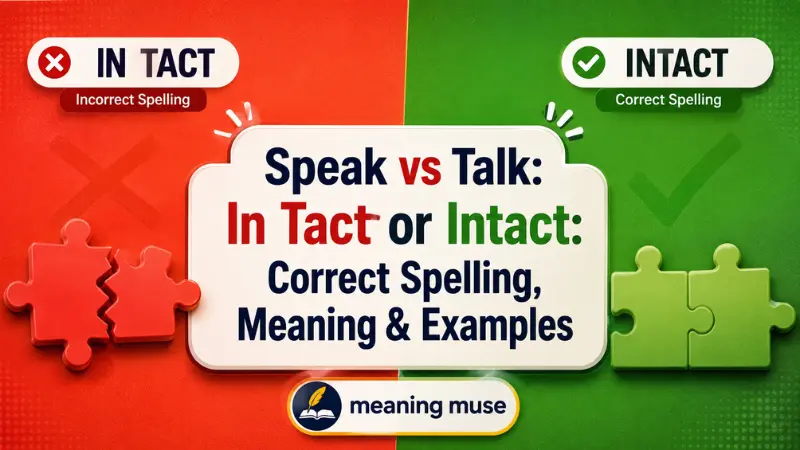
In tact or intact? If you mean “whole,” “complete,” or “not damaged,” the correct spelling is intact—one word.
For example:
The package arrived intact.
The two-word form in tact is a common spelling mistake. It is not the standard form for this meaning.
This small spelling mistake is easy to make because in and tact are both real English words. However, intact is a single adjective with its own meaning.
Quick Answer
Intact is the correct spelling when you mean that something is whole, complete, untouched, or undamaged.
In tact is not the standard spelling of this word.
| Context | Best Choice | Why |
|---|---|---|
| Something is whole or undamaged | intact | This is the standard spelling. |
| Something remains complete | intact | It describes something that has not been broken or changed. |
| Something survives without damage | intact | It means the thing remains whole. |
| Writing “in tact” as two words | Avoid it | It is a spelling error when used with the meaning “whole.” |
A simple rule will help:
If you mean “whole” or “undamaged,” use intact.
Why People Confuse Them
The mistake happens because intact looks like it could be made from the words in + tact.
But that is not how the modern word works.
Intact is one established adjective. It means that something has remained whole, complete, or unchanged.
The separate word tact is also correct, but it has a different meaning. Tact is a noun for skill in dealing with people or sensitive situations without causing unnecessary offense. Merriam-Webster gives meanings such as sensitivity and good judgment in social situations.
So compare:
- The vase remained intact.
- She handled the complaint with tact.
The first sentence is about something staying whole. The second is about handling a person or situation carefully.
Key Differences At A Glance
The main point is simple: intact is the correct word for the meaning “whole or undamaged.”
| Feature | In tact | Intact |
| Standard spelling | No | Yes |
| Number of words | Two | One |
| Meaning “whole” | No | Yes |
| Meaning “undamaged” | No | Yes |
| Standard US English | No | Yes |
| Common mistake | Yes | No |
There is no special US spelling that changes this answer. Intact is used in both American and British English. Collins lists the same spelling in its American and British entries.
Are They the Same Word?
When someone writes in tact to mean “whole” or “undamaged,” they are almost always trying to write intact.
They are not two accepted spellings of the same word.
Intact is an adjective. It describes something that has not been damaged, broken, altered, or diminished. Collins defines it as complete and not damaged or changed.
For example:
- The old building is still intact.
- The documents were kept intact.
- Her confidence remained intact.
- The original design is still intact.
The word can describe both physical things and ideas or conditions.
A building can remain intact after a storm. A plan, agreement, reputation, friendship, or belief can also remain intact when it has not been damaged or weakened.
US vs UK Preference
For this word, there is no meaningful US-versus-UK spelling difference.
American English uses intact.
British English also uses intact.
Collins lists intact in both its American English and British English entries, with the basic idea of something being untouched, unimpaired, complete, or whole.
So you do not need to choose between a US version and a UK version.
Use:
intact
Whether you are writing for:
- a US school
- an American workplace
- a British reader
- an international audience
- a formal report
- an email
- a website
The spelling stays the same.
Which Spelling Should You Use?
Use intact whenever you want to say that something remains whole, complete, safe, or undamaged.
Correct examples
- The package arrived intact.
- The glass was still intact after the move.
- The original document remained intact.
- The family stayed intact despite the difficult year.
- The agreement remains intact.
- The old photos were surprisingly intact.
Incorrect examples
- The package arrived in tact.
- The glass was still in tact.
- The original document remained in tact.
- The agreement remains in tact.
In all of these examples, change in tact to intact.
When One Spelling Looks Wrong
In tact may look natural at first because English often uses in as a separate word:
- in place
- in time
- in order
- in good condition
That pattern can make in tact seem reasonable.
But intact is not one of those two-word expressions. It is a single word.
A useful memory trick is:
Intact = in one piece.
If something stays whole and nothing important is broken or missing, write intact.
You can also connect it with words such as:
- undamaged
- whole
- complete
- unbroken
- unchanged
If one of those meanings fits your sentence, intact is probably the word you need.
Common Mistakes (and Quick Fixes)
Mistake 1: Writing “in tact”
Wrong:
The package arrived in tact.
Right:
The package arrived intact.
Mistake 2: Treating “intact” as two words
Wrong:
The original structure is still in tact.
Right:
The original structure is still intact.
Mistake 3: Confusing “intact” with “tact”
These words have different jobs.
Intact describes a condition:
The painting remained intact.
Tact describes a social skill:
She handled the difficult conversation with tact.
Mistake 4: Thinking the two-word version is a US/UK difference
It is not.
American and British English both use intact for the standard word.
Mistake 5: Using “intact” when you mean “tactful”
These words should not be mixed up.
- intact = whole or undamaged
- tact = skill in dealing with sensitive situations
- tactful = showing tact
For example:
The vase remained intact.
But:
The manager gave a tactful answer.
Everyday Examples
Here are natural examples you might see in everyday American English.
Packages and Objects
The box arrived intact despite the rough handling.
The box was still whole and undamaged.
The phone survived the fall intact.
The phone was not seriously damaged.
Documents
Please return the signed contract intact.
The document should remain complete and undamaged.
The original records are still intact.
The records have been preserved.
Buildings and Places
Much of the historic building remains intact.
The building has kept much of its original structure.
The cabin was surprisingly intact after the storm.
The cabin was still largely whole.
Plans and Agreements
The original plan remains intact.
The plan has not been changed or weakened.
Their agreement stayed intact after the disagreement.
The agreement continued to exist.
Relationships and Trust
Their friendship remained intact.
Their friendship survived the difficult situation.
Her trust in the team remained intact.
Her trust was not damaged or reduced.
Nature and History
The ancient artifact was found almost completely intact.
The artifact had survived with little damage.
The historic records have remained intact for generations.
The records have been preserved without major loss or damage.
Dictionary-Style Word Details
Verb
In tact: Not a standard verb or standard spelling of the adjective intact.
Intact: Not normally used as a verb. It is primarily an adjective.
Examples:
- The painting is intact.
- The documents remained intact.
Do not create verb forms such as “intacted” when you mean “kept whole.” Use a clearer verb such as preserved, protected, or kept when appropriate.
Noun
In tact: Not a standard noun.
Intact: Primarily an adjective. A related noun form, intactness, exists, referring to the state of being intact.
The separate noun tact is different. It means skill or sensitivity in handling people and delicate situations.
Synonyms
For intact, useful synonyms include:
- whole
- complete
- undamaged
- unbroken
- unchanged
- unimpaired
These are not always perfect replacements in every sentence, so choose the one that best fits the context. Collins lists undamaged, whole, complete, and sound among the synonyms associated with intact.
For in tact, there are no standard synonyms because it is not the standard spelling of the intended word.
For the separate word tact, closest plain alternatives include:
- sensitivity
- diplomacy
- consideration
Example Sentences
Intact:
- The package arrived intact.
- The vase remained intact after the move.
- The original document is still intact.
- The historic building survived largely intact.
- Their friendship remained intact.
- The basic plan is still intact.
- The computer was found intact after the accident.
- Her confidence remained intact.
- The old photographs were surprisingly intact.
- The agreement stayed intact after the meeting.
In tact:
When the intended meaning is “whole,” “complete,” or “undamaged,” replace in tact with intact.
Word History
Intact comes from Latin intactus, meaning “untouched.” Collins traces the English word to Middle English and gives the Latin origin as part of its word history.
The important point for modern writers is that intact is established as one word.
The spelling should not be separated into in tact when you mean “whole” or “undamaged.”
Phrases Containing
Common phrases with intact include:
- remain intact
- stay intact
- keep intact
- largely intact
- mostly intact
- still intact
- fully intact
- remain completely intact
- leave something intact
- preserve something intact
For example:
The original structure remained intact.
Most of the historic features are still intact.
The package arrived fully intact.
These patterns are natural because intact describes something that continues to be whole, complete, or undamaged.
FAQs
Is “in tact” or “intact” correct?
Intact is the correct spelling when you mean whole, complete, untouched, or undamaged. In tact is not the standard spelling for this meaning.
What does “intact” mean?
Intact means something is still whole, complete, or undamaged. For example: “The package arrived intact.”
Is “in tact” ever correct?
Not when you mean “whole” or “undamaged.” In standard American English, use intact as one word.
Is “intact” one word or two?
Intact is one word. Writing it as in tact is a common spelling mistake.
Is “intact” used in American English?
Yes. Intact is standard in American English. It is also used in British English, so there is no US-versus-UK spelling difference for this word.
What is an easy way to remember “intact”?
Remember: intact = whole or undamaged. If something remains in one piece, write intact.
What is an example of “intact” in a sentence?
“The old vase remained intact after the move.”
What is the difference between “intact” and “tact”?
Intact means whole or undamaged. Tact is a noun meaning skill or sensitivity when dealing with people or difficult situations.
Example: “The painting remained intact.”
Example: “She handled the complaint with tact.”
Can “intact” describe an idea or relationship?
Yes. Intact can describe things that are not physical. For example, “Their friendship remained intact” means their friendship survived without being damaged.
What are synonyms for “intact”?
Common synonyms include whole, complete, undamaged, unbroken, unchanged, and unimpaired. The best synonym depends on the sentence.
Conclusion
When you are choosing between in tact and intact, the answer is straightforward:
Use intact.
It is one word and means whole, complete, untouched, unbroken, or undamaged.
In tact is not the standard spelling when you want that meaning.
Remember this simple rule:
Whole or undamaged = intact.
So write:
The package arrived intact.
Not:
The package arrived in tact.
Once you remember that intact is one word, this common spelling mistake becomes easy to avoid.