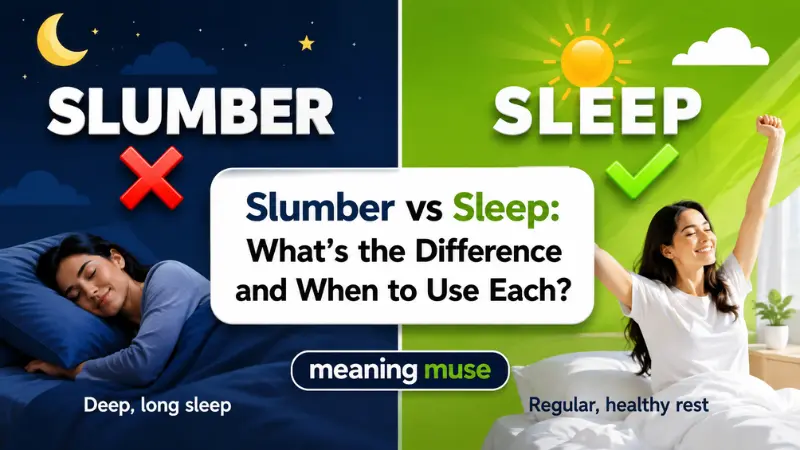
Slumber vs sleep can be confusing because both words talk about resting while you are not awake.
In many sentences, they can describe the same basic action. However, they do not sound the same.
Sleep is the normal word people use every day. You can talk about getting enough sleep, going to sleep, sleeping late, or needing more sleep.
Slumber is less common in normal conversation. It often sounds softer, more poetic, or more literary. Some dictionary meanings also connect it with light sleep or dozing.
That means the main difference is usually not whether a person is asleep. The bigger difference is tone, style, and context.
Quick Answer
Sleep is the common, general word for the natural resting state when a person or animal is not awake.
Slumber also means sleep, but it often sounds literary, gentle, old-fashioned, or poetic. It can also refer especially to light sleep or dozing.
Use sleep in normal everyday English.
Use slumber when you want a softer, more expressive, or literary tone.
Example:
- “The baby is sleeping.” — normal and natural
- “The baby slumbers peacefully.” — softer and more literary
Why People Confuse Slumber and Sleep
People confuse these words because their meanings overlap.
If someone is slumbering, that person is sleeping.
Because of this overlap, the words may look completely interchangeable. They are not always interchangeable in natural English.
The word sleep works in almost every ordinary situation.
You can say:
- I need more sleep.
- The dog is sleeping.
- She went to sleep early.
- He slept for eight hours.
The word slumber is more limited.
You may see it in:
- stories
- poems
- descriptive writing
- older expressions
- peaceful descriptions
- figurative language
Cambridge labels the verb slumber as literary, which helps explain why it is less common in simple everyday conversation.
Key Differences at a Glance
| Context | Best Choice | Why |
|---|---|---|
| Everyday conversation | Sleep | Natural and common |
| School writing | Sleep | Clear and simple |
| Talking about rest | Sleep | Broad everyday meaning |
| Medical or factual context | Sleep | Standard general term |
| Stories and poems | Slumber | More literary |
| Peaceful description | Slumber | Softer tone |
| Light dozing | Slumber | Can suggest lighter sleep |
| Figurative inactivity | Slumber | Can describe something dormant |
Simple Comparison
- Sleep: common, neutral, broad
- Slumber: literary, softer, less common
- Sleep: normal for daily speech
- Slumber: useful for style or mood
- Sleep: can mean any normal sleeping state
- Slumber: may especially suggest light or peaceful sleep
The safest rule is simple:
Use “sleep” for everyday meaning and “slumber” when style or tone matters.
Are Slumber and Sleep the Same?
They are close in meaning, but they are not exactly the same in use.
Both can be nouns.
Sleep:
“I need some sleep.”
Slumber:
“He woke from a peaceful slumber.”
Both can also be verbs.
Sleep:
“The children sleep upstairs.”
Slumber:
“The children slumbered quietly.”
Merriam-Webster gives slumber both the meaning “sleep” and the more specific sense of sleeping lightly or dozing. Cambridge also defines the verb simply as “to sleep” while marking it literary.
So it would be wrong to say that slumber always means one special stage of sleep.
The better difference is this:
Sleep describes the state directly. Slumber often adds a softer or more literary feeling.
Does Slumber Mean Deep Sleep?
Not always.
This is one of the biggest mistakes people make with slumber vs sleep.
You may see phrases such as:
- deep slumber
- peaceful slumber
- long slumber
Because of these phrases, some people assume that slumber itself means deep sleep.
That is too strong.
Major dictionaries also give slumber the meaning of light sleep or dozing.
The phrase deep slumber works because the word deep tells us what kind of slumber it is.
Compare:
He fell into a deep slumber.
Here, deep makes the sleep sound heavy.
She slumbered lightly on the couch.
Here, the person is only resting lightly.
So do not use this rule:
Slumber = deep sleep
Use this better rule:
Slumber = sleep, often described in a softer, literary, peaceful, or sometimes lighter way.
When Should You Use Sleep?
Use sleep in most everyday situations.
It is the best choice when you are talking plainly about rest.
Everyday Conversation
I need to sleep.
This sounds completely natural.
I need to slumber.
The meaning is clear, but it sounds unusual in normal modern conversation.
Talking About How Long Someone Rests
I slept for seven hours.
This is natural.
I slumbered for seven hours.
This sounds more like something from a story.
Talking About Sleep Problems
Use sleep when discussing ordinary problems with rest.
For example:
I could not sleep last night.
She has trouble sleeping.
The noise kept the baby from sleeping.
The word sleep is broad enough for normal, practical, and factual uses. Cambridge defines it as the resting state in which the body is inactive and consciousness is reduced.
Giving Instructions
Go to sleep.
Natural.
Go to slumber.
Unusual.
For simple modern American English, sleep is almost always the safer choice.
When Should You Use Slumber?
Use slumber when you want the sentence to sound more expressive.
In Stories
The princess remained in a long slumber.
This has a fairy-tale feeling.
In Peaceful Descriptions
The child slumbered beneath a warm blanket.
The sentence sounds soft and calm.
In Poetry
Writers may choose slumber because it gives a sentence a slower, gentler feeling.
The village slumbered beneath the moon.
Here, the village is not literally sleeping like a person.
The word creates an image of stillness and quiet.
For Light Sleep
Because slumber can carry the meaning of light sleep or dozing, it may also work when someone is resting without sounding fully or deeply asleep.
For Figurative Inactivity
Slumber can also describe something that is inactive, dormant, or quiet.
For example:
The old volcano had slumbered for years.
In this sentence, the volcano is not literally sleeping. The word means that it has remained inactive. Collins and Merriam-Webster both record this figurative sense.
Slumber vs Sleep in American English
Both words are correct in American English.
There is no spelling rule that makes one American and the other British.
The difference is mainly how often they are used and what tone they create.
Sleep is normal in everyday American speech.
People commonly say:
- get some sleep
- go to sleep
- sleep well
- sleep late
- sleep through the night
- lose sleep
- fall asleep
- need sleep
Slumber appears less often in normal speech.
One well-known American phrase is slumber party, meaning a gathering where children spend the night at another child’s home. Cambridge marks slumber party as a US term.
Outside expressions like this, slumber usually sounds more literary than sleep.
Common Mistakes and Quick Fixes
Mistake: Saying Slumber Always Means Deep Sleep
Wrong idea: Slumber is always deeper than sleep.
Better: Slumber can simply mean sleep and may also mean light sleep or dozing.
Mistake: Using Slumber in Every Sentence
Awkward:
“I was tired, so I went home to slumber.”
Better:
“I was tired, so I went home to sleep.”
The second sentence sounds natural in everyday American English.
Mistake: Thinking Sleep and Slumber Are Different Sleep Stages
They are English vocabulary words, not names for separate scientific sleep stages.
Do not treat slumber as a technical label for one exact stage of sleep.
Mistake: Thinking Slumber Is Incorrect or Outdated
Slumber is still a valid English word.
It simply has a more literary feel in many modern uses. Cambridge continues to list it as a noun and verb, with the verb marked literary.
Mistake: Saying Slumber Can Only Describe People
It can also be used figuratively.
The town slumbered in the summer heat.
The volcano continued to slumber.
The meaning is inactivity, quietness, or stillness rather than literal sleep.
Everyday Examples
Examples With Sleep
I need more sleep tonight.
The baby finally went to sleep.
My dog sleeps beside the couch.
Did you sleep well?
She slept through the storm.
The children were sleeping upstairs.
I could not sleep because of the noise.
He usually sleeps for seven hours.
These sentences are simple and natural.
Examples With Slumber
The baby slumbered peacefully in the crib.
He woke from a light slumber.
The old town slumbered beneath the stars.
She fell into a peaceful slumber.
The giant remained in an enchanted slumber.
The volcano had slumbered for many years.
These examples feel more descriptive or literary.
Compare Them Side by Side
Sleep:
“The dog slept near the fire.”
Normal and direct.
Slumber:
“The old dog slumbered peacefully near the fire.”
Softer and more descriptive.
Sleep:
“The town was quiet at night.”
Slumber:
“The town slumbered beneath the moon.”
The second sentence uses figurative language.
Sleep:
“She went to sleep after dinner.”
Very natural.
Slumber:
“She slipped into a gentle slumber after dinner.”
More literary.
Dictionary-Style Word Details
Verb
Sleep
As a verb, sleep means to be in the natural resting state of sleep. Its past tense and past participle are slept.
Examples:
I sleep better when the room is cool.
She slept late on Sunday.
The baby is sleeping now.
Slumber
As a verb, slumber means to sleep. It may especially suggest light sleeping or dozing and often has a literary tone. Its regular past form is slumbered.
Examples:
He slumbered in the chair.
The child was slumbering quietly.
The village slumbered under the stars.
Noun
Sleep
As a noun, sleep means the natural resting state.
Examples:
I need more sleep.
She had a good night’s sleep.
Slumber
As a noun, slumber can mean sleep or a period of sleep. It can also suggest light sleep.
Examples:
The noise woke him from his slumber.
She fell into a peaceful slumber.
Synonyms
For sleep, useful related words include:
- rest
- doze
- nap
- snooze
For slumber, close alternatives include:
- sleep
- doze
- nap
- rest
Merriam-Webster lists sleep, rest, nap, doze, and snooze among close alternatives for slumber.
These words are related, but they are not always exact replacements.
For example, a nap usually means a shorter period of sleep.
A doze often means light sleep.
Example Sentences
Sleep: I need to sleep before the long drive.
Slumber: The child slumbered in the back seat.
Sleep: We slept for eight hours.
Slumber: He woke from a peaceful slumber.
Sleep: The cat sleeps on my bed.
Slumber: The cat slumbered beside the fireplace.
Sleep: She could not sleep because of the thunder.
Slumber: The quiet house seemed to slumber in the rain.
Word History
Both words have been part of English for a long time, but they developed along different paths.
Slumber has roots in Middle and Old English forms connected with sleep and dozing. Collins records Middle English and Old English forms behind the modern word.
Today, the history of the word helps explain why slumber can carry an older or more literary sound.
Sleep, by contrast, is the broad everyday word that remains central to ordinary modern English.
The important point for modern writers is not memorizing old forms.
It is knowing that sleep sounds neutral, while slumber often adds style.
Phrases Containing
Common phrases with sleep include:
- go to sleep
- fall asleep
- get some sleep
- lose sleep
- sleep well
- sleep late
- sleep through
- sleep in
Example:
I plan to sleep in tomorrow.
Merriam-Webster records sleep in for sleeping late intentionally.
Common phrases with slumber include:
- deep slumber
- peaceful slumber
- light slumber
- slumber party
Example:
The kids are having a slumber party tonight.
The phrase slumber party is especially familiar in American English.
FAQs
What is the main difference between slumber and sleep?
Sleep is the common, neutral word for resting while not awake. Slumber also means sleep but often sounds more literary, peaceful, or old-fashioned and can suggest light sleeping or dozing.
Does slumber mean deep sleep?
No. Slumber can be used in the phrase deep slumber, but the word itself does not always mean deep sleep. Dictionaries also give it the meaning of light sleep or dozing.
Is slumber another word for sleep?
Yes. Slumber can be a synonym for sleep. However, it often carries a more literary or gentle tone.
Is slumber used in American English?
Yes. It is a valid American English word. However, sleep is more natural for everyday situations. Slumber party is also a familiar US expression.
Can slumber be used as a verb?
Yes. You can say “The baby slumbered peacefully.” Cambridge and Merriam-Webster both list slumber as a verb meaning to sleep.
Can slumber be a noun?
Yes. You can say “He woke from his slumber.” As a noun, it means sleep or a period of sleep.
Which word should beginners use?
Use sleep in most everyday sentences.
It is simpler, more common, and works in far more situations.
Use slumber when you specifically want a literary, gentle, poetic, or descriptive tone.
Conclusion
The difference between slumber vs sleep is mostly about tone and usage.
Sleep is the broad, everyday word. It is the natural choice when talking about rest, bedtime, sleep habits, or someone who is not awake.
Slumber also means sleep, but it often sounds softer and more literary. It can also suggest light sleep or dozing, and writers sometimes use it for things that are quiet or inactive.
Remember this easy rule:
Use “sleep” for normal everyday English. Use “slumber” when you want a softer or more literary feeling.
That simple difference will help you choose the right word in most sentences.