Many English writers wonder whether ofcourse or of course is the correct spelling. The two forms look almost identical, and when people say the phrase aloud, the words often sound connected.
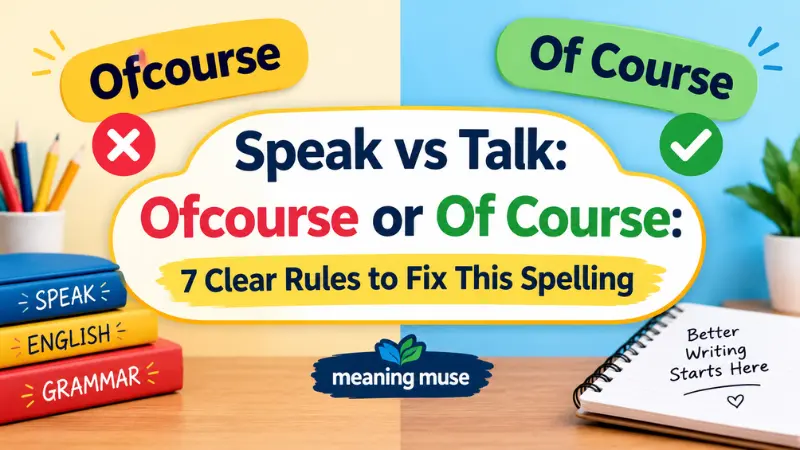
The correct spelling is of course. It should always be written as two separate words when it means “certainly,” “naturally,” or “yes.” The combined form ofcourse is not a standard English spelling.
This small spacing mistake is common because English has many words that combine over time. However, this phrase has kept its two-word form in standard writing.
Quick Answer
Of course is the correct spelling. Ofcourse is not accepted as a standard English word and is usually treated as a spelling mistake.
Use of course in emails, school writing, professional messages, articles, and everyday communication.
Examples:
- Correct: Of course, I can help you.
- Incorrect: Ofcourse, I can help you.
Why People Confuse Them
People often confuse ofcourse or of course because the phrase sounds like one unit when spoken.
In natural conversation, speakers usually do not pause between “of” and “course.” This makes it easy to imagine that the phrase should be written as one word.
Another reason is that English contains many combined words, such as “sometimes” and “however.” Because of this pattern, some writers assume that frequently used phrases can also merge into one word.
However, frequency does not always change spelling. Some expressions remain separate even when they are used together often.
Key Differences At A Glance
| Feature | Ofcourse | Of course |
|---|---|---|
| Standard spelling | No | Yes |
| Number of words | One | Two |
| Meaning | No separate standard meaning | Certainly, naturally, or obviously |
| Use in formal writing | Avoid | Recommended |
Additional comparison:
| Context | Best Choice | Why |
|---|---|---|
| Professional email | Of course | It follows standard spelling |
| Casual conversation | Of course | Common everyday expression |
| School assignment | Of course | Recognized written form |
| Online typing mistake | Correct to of course | The space should be restored |
Are They the Same Word?
No. Ofcourse and of course are not two accepted spellings of the same word.
Of course is a common English expression made of two separate words. It is used to show agreement, certainty, or that something is expected.
Ofcourse does not function as a recognized alternative spelling. It is normally a typing mistake caused by joining two words together.
The meaning belongs to of course, not to the incorrect combined form.
US vs UK Preference
There is no major US versus UK spelling difference for this phrase.
American English and British English both use of course as the standard form. The difference is not about regional preference; it is about correct spacing.
Writers in both varieties of English should use the two-word spelling in formal and general writing.
Which Spelling Should You Use?
You should use of course whenever you want to express:
- certainty
- agreement
- permission
- something expected or obvious
Examples:
- “Can I borrow your book?”
“Of course.” - “Of course we need a plan before starting.”
- “She was, of course, excited about the opportunity.”
The phrase works well at the beginning, middle, or end of a sentence.
When One Spelling Looks Wrong
The spelling ofcourse can look incorrect because it combines two words that should remain separate.
Readers usually understand what the writer means, but the missing space can make the writing appear less careful.
This is especially noticeable in:
- resumes
- business communication
- academic writing
- published content
Using the correct form helps your writing look polished and professional.
Common Mistakes
Mistake 1: Joining the words
Incorrect:
Ofcourse I will attend the meeting.
Correct:
Of course I will attend the meeting.
Mistake 2: Confusing “of course” with “off course”
These phrases have different meanings.
- Of course = certainly or naturally
- Off course = away from the correct direction or plan
Example:
- The answer is of course correct.
- The ship went off course during the storm.
Mistake 3: Removing spaces because of texting habits
Fast typing can create combined forms. Before publishing or sending important writing, check common phrases that may have lost spaces.
Everyday Examples
Here are natural examples using the correct spelling:
- Of course, I would love to join you.
- You can ask questions, of course.
- Of course she remembered your birthday.
- “Are you ready?” “Of course.”
- The project was difficult, but of course it was worth completing.
These examples show how flexible the phrase is in everyday American English.
Dictionary-Style Word Details
Verb
Neither of course nor ofcourse is a verb.
The phrase does not describe an action. Instead, it works as an expression that adds meaning to a sentence.
Noun
Neither spelling functions as a noun.
The word course by itself can be a noun, but the full phrase of course has a different role as an expression.
Synonyms
Closest plain alternatives for of course include:
- certainly
- naturally
- yes
- obviously
The best choice depends on the sentence and tone.
Example Sentences
Correct examples:
- Of course, I understand your point.
- She will, of course, arrive on time.
- “Can you help me?” “Of course.”
Incorrect example:
- Ofcourse, I understand your point.
Word History
The expression comes from the older use of “course” meaning a normal path, order, or expected progression. Over time, of course developed meanings connected with what is natural or expected.
Phrases Containing
Common phrases include:
- of course not
- of course you can
- as a matter of course
These expressions keep the two-word spelling.
FAQs
Is it ofcourse or of course?
Of course is correct. Ofcourse is not the standard spelling.
Is of course one word or two?
It is two words: of course.
Can I write ofcourse in casual texting?
You may see it online, but standard writing uses of course.
Do Americans and British speakers spell it differently?
No. Both American and British English use of course.
What does of course mean?
It usually means certainly, naturally, or yes.
Is off course the same as of course?
No. Off course means away from a planned direction, while of course means certainly or naturally.
Conclusion
The correct choice between ofcourse or of course is simple: use of course.
The phrase remains two separate words in standard English. Although people sometimes combine the words while typing quickly, ofcourse is not the accepted spelling.
Remember this simple rule: when you mean “certainly” or “naturally,” always write of course.
Suggested Internal Links
- Common English Spelling Mistakes → /common-spelling-mistakes/
- Confusing English Words Guide → /confusing-words/
- American English Usage Tips → /american-english-guide/