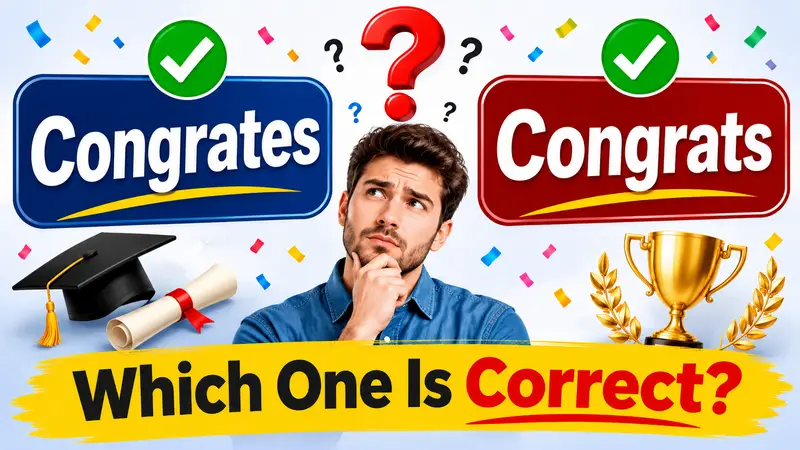
When congratulating someone on a birthday, graduation, new job, promotion, or personal achievement, you might wonder whether to write congrates or congrats. Both spellings look similar, but only one is accepted in standard English.
The correct spelling is congrats. It is a shortened, informal form of congratulations and is widely used in text messages, emails, social media posts, and everyday conversations. Congrates is a common misspelling and should generally be avoided in both formal and informal writing.
Quick Answer
Congrats is the correct spelling. It is an informal abbreviation of congratulations, used to express praise or happiness about someone’s achievement or good news. Congrates is not a standard English spelling. If you want to congratulate someone, write “Congrats!” or use the full word “Congratulations!”
What Does “Congrats” Mean?
Congrats is a shortened form of congratulations. People use it to show happiness, appreciation, or excitement when someone experiences success or shares good news.
It is commonly used for personal achievements and happy occasions, including:
- Getting a new job or promotion.
- Graduating from school or college.
- Getting married or engaged.
- Having a baby.
- Winning a competition or award.
- Buying a new home.
- Reaching an important personal goal.
For example:
- “Congrats on your new job!”
- “Huge congrats on graduating!”
- “Congrats! You really earned this.”
- “Congratulations on your wedding!”
The word can work as a standalone expression or as part of a sentence. Dictionaries classify it as an informal noun or exclamation. English meaning – Cambridge Dictionary+2
Why Is “Congrates” Incorrect?
The spelling congrates is not the standard shortened form of congratulations. It is usually a spelling mistake caused by confusion about how the longer word is written or pronounced.
The correct shortened form is congrats, which removes most of the longer word while retaining its familiar beginning and ending sound.
Remember:
- Correct: Congrats!
- Incorrect: Congrates!
- Correct: Congratulations!
- Incorrect: Congrates on your success!
If you are writing a message, social media comment, greeting card, or email, choose congrats rather than congrates.
Congrats vs. Congrates: Key Differences
| Feature | Congrats | Congrates |
|---|---|---|
| Spelling | Correct | Incorrect for this meaning |
| Meaning | Congratulations | No standard meaning as a congratulatory expression |
| Usage | Common and informal | Usually a spelling mistake |
| Grammar | Noun or exclamation | Not the standard form |
| Appropriate for messages | Yes | No |
The important point is that congrats is an established English expression, while congrates should not be used as its replacement.
When Should You Use “Congrats”?
Use congrats when communicating casually with friends, family members, classmates, coworkers, or people you know.
It is especially suitable for short messages and friendly conversations.
1. In text messages
“Congrats on passing your driving test!”
2. On social media
“Congrats to everyone who graduated this year!”
3. In workplace conversations
“Congrats on getting the promotion. Well deserved!”
4. In birthday or celebration messages
“Congrats on another wonderful milestone!”
5. In personal conversations
“That’s amazing news! Congrats!”
Although the expression is acceptable in many workplace conversations, a formal letter or professional announcement may sound better with the full word congratulations.
Is “Congrats” Formal or Informal?
Congrats is an informal expression. It is friendly, natural, and widely understood in American English.
Here is how to choose the right expression:
| Situation | Recommended expression |
|---|---|
| Texting a friend | Congrats! |
| Commenting on Instagram | Congrats! |
| Congratulating a coworker | Congrats on the promotion! |
| Writing a formal business letter | Congratulations |
| Sending an official announcement | Congratulations |
For professional communication, the full form is generally the safer choice. However, congrats is perfectly natural in friendly workplace messages.
Common Mistakes to Avoid
Here are some mistakes people may make when writing congratulatory messages.
Mistake 1: Adding an extra “e”
Incorrect: Congrates on your graduation!
Correct: Congrats on your graduation!
Mistake 2: Using the wrong expression in formal writing
Less formal: Congrats on your appointment.
More formal: Congratulations on your appointment.
Both are understandable, but the second sounds more polished.
Mistake 3: Using the wrong preposition
Less natural: Congrats for your promotion!
Better: Congrats on your promotion!
The usual construction is congrats on followed by the achievement or occasion.
Mistake 4: Confusing “congrats” with “congratulate”
- Congrats: An informal expression of congratulations.
- Congratulate: A verb describing the act of expressing praise or happiness.
Example:
“I want to congratulate you on your achievement.”
“Congrats on your achievement!”
Both sentences communicate similar feelings, but their grammatical structures are different.
What Are Some Alternatives to “Congrats”?
If you want to congratulate someone without repeating the same expression, you can use these alternatives:
| Expression | Best use |
|---|---|
| Congratulations! | General and formal situations |
| Well done! | Recognizing an achievement |
| Great job! | Praising someone’s effort |
| Way to go! | Friendly encouragement |
| Bravo! | Praising an impressive performance |
| I’m happy for you! | Expressing personal happiness |
| You deserve it! | Recognizing someone’s hard work |
Choose an expression that matches your relationship with the person and the occasion.
FAQs
1. Is “congrates” a real word?
Congrates is not a standard English spelling used to congratulate someone. The accepted informal spelling is congrats, which is short for congratulations.
2. Is “congrats” short for congratulations?
Yes. Congrats is an informal abbreviation of congratulations. It carries the same basic message of happiness or praise for someone’s success or good news. Oxford Learner’s Dictionaries+1
3. Can I use “congrats” in a professional email?
Yes, particularly when communicating with colleagues in a friendly workplace environment. However, congratulations is more appropriate for formal business correspondence, official announcements, and professional letters.
4. Is “congrats” grammatically correct?
Yes. It is an established informal English expression that functions as a noun or an exclamation. For example, “Congrats on your achievement!” is grammatically natural.
5. What is the difference between “congrats” and “congratulations”?
Both expressions communicate happiness or praise for someone’s good news or achievement. Congrats is the shorter, more informal version, while congratulations is suitable for both formal and informal situations.
6. How do you spell congrats correctly?
The correct spelling is C-O-N-G-R-A-T-S. It does not contain an additional “e” before the final “s.”
Conclusion
The correct choice is congrats, not congrates, when you want to congratulate someone. It is a widely recognized informal abbreviation of congratulations and works naturally in text messages, social media comments, and everyday conversations.
Remember to use congratulations when a more formal tone is appropriate. Whether you are celebrating a graduation, promotion, wedding, or personal achievement, choosing the correct spelling makes your message clear and natural.