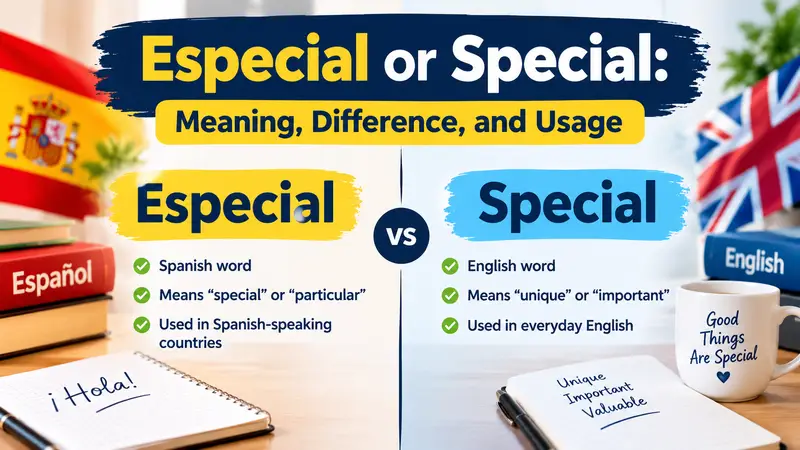
If you are unsure whether to write especial or special, both are legitimate English words. They share similar meanings, including particular, exceptional, and noteworthy. However, special is much more common in everyday American English, while especial generally sounds more formal, literary, or deliberate.
Although the two words sometimes work interchangeably, they are not always equally natural. Understanding their subtle difference will help you choose the right word for conversations, professional writing, and academic sentences.
Quick Answer
Both especial and special are correct adjectives. However, special is the preferred choice in most everyday situations because it describes something unusual, important, or different from the ordinary. Especial usually emphasizes something particularly important or noteworthy and appears more often in formal writing.
What Does Special Mean?
Special is an adjective that describes something different from the usual, particularly important, unique, or designed for a particular purpose.
It can describe people, occasions, objects, relationships, and experiences.
Examples:
- We planned a special dinner for our anniversary.
- She has a special talent for teaching children.
- This package includes special features.
- Today is a special day for our family.
In these examples, special communicates that something deserves attention because of its importance, purpose, or unusual qualities.
Common Meanings of Special
Depending on the sentence, special can mean:
- Unusual: Something different from what normally happens.
- Important: Something that deserves particular attention.
- Unique: Something that has distinctive qualities.
- Specific: Something intended for a particular purpose.
- Exceptional: Something that stands out from others.
For example, a special offer is an offer with particular conditions, while a special occasion is an event with personal or social importance.
What Does Especial Mean?
Especial is an adjective meaning particularly important, exceptional, noteworthy, or specific.
It shares much of its meaning with special, but it has a more formal or literary tone.
Examples:
- The teacher paid especial attention to the new students.
- Her safety is of especial concern to the organization.
- The project deserves especial consideration.
- He showed especial kindness toward his younger colleagues.
In these sentences, especial adds emphasis to the importance of something.
It is a valid English word, not a spelling mistake. However, many American readers will find special more natural in ordinary conversation.
Especial vs. Special: Main Differences
| Feature | Especial | Special |
|---|---|---|
| Part of speech | Adjective | Adjective |
| Meaning | Particularly important or noteworthy | Unusual, important, unique, or specific |
| Usage | Less common | Very common |
| Tone | Formal or literary | Neutral and versatile |
| Everyday conversation | Less natural | Preferred |
| Professional writing | Appropriate in certain contexts | Appropriate in most contexts |
The most important distinction is usage rather than a completely different dictionary meaning.
For example:
- Especial attention was given to the issue.
- Special attention was given to the issue.
Both sentences are understandable and correct. The second sounds more natural in most contemporary American writing.
When Should You Use Special?
Choose special when you want a natural, familiar word that works in everyday communication.
It is suitable for:
Everyday conversations
- You are a special friend to me.
- We are planning something special.
Business communication
- We have a special offer for new customers.
- The company introduced a special training program.
Academic writing
- Researchers identified a special condition affecting the results.
- The study requires special attention.
Personal occasions
- She organized a special birthday celebration.
- This is a special memory for our family.
Special is flexible enough for both casual and formal situations.
When Should You Use Especial?
Use especial when you deliberately want to emphasize particular importance or distinction, especially in formal or carefully written prose.
Examples:
- The matter is of especial importance.
- We are grateful for your especial support.
- The committee gave especial consideration to the proposal.
Although these sentences are correct, replacing especial with special would usually make them sound more natural to a general American audience.
Common Mistakes to Avoid
Mistake 1: Assuming especial is incorrect.
Incorrect assumption: Especial is not a real English word.
Correct explanation: Especial is a legitimate adjective with a meaning similar to special.
Mistake 2: Using especial in every situation.
Less natural: We had an especial birthday party.
More natural: We had a special birthday party.
Mistake 3: Thinking the words always have identical usage.
Although their definitions overlap, their tone and frequency differ. Special is more versatile, while especial is generally more restricted to formal or emphatic contexts.
Are Especially and Specially Related?
Yes. Especially and specially are adverbs related to the adjectives especial and special, but their usage has developed distinct preferences.
- Especially generally means particularly or above all.
- Specially often means specifically or for a particular purpose.
Examples:
- I especially enjoyed the final chapter.
- This room was specially designed for children.
The distinction is useful because choosing the right adverb can make your sentence clearer.
Frequently Asked Questions
Is especial a real English word?
Yes. Especial is a recognized English adjective meaning particularly important, noteworthy, or exceptional. It is less common than special, particularly in everyday American conversation.
Is special or especial more commonly used in America?
Special is much more common in American English. It works naturally in conversations, business writing, academic work, and personal communication.
Can especial and special be used interchangeably?
Sometimes. Both can describe something particularly important or noteworthy. However, special has additional everyday uses involving unusual qualities and specific purposes.
Is especial formal or informal?
Especial is generally considered formal or literary. It is more likely to appear in carefully written prose than in casual conversations.
What is the difference between especial and especially?
Especial is an adjective, while especially is an adverb. Especial describes something particularly important, whereas especially modifies a verb, adjective, or another expression to mean particularly or above all.
Should I use especial in professional writing?
You can, especially when emphasizing particular importance. However, special is usually the safer and more natural choice for general professional communication.
Conclusion
Both especial and special are correct English words with closely related meanings. The main difference is their tone and everyday usage. Special is the natural choice for most American English situations, while especial offers a more formal way to emphasize particular importance or distinction.
When in doubt, choose special.
Article 2: Labtop or Laptop
SEO Title: Labtop or Laptop: Correct Spelling and Meaning Explained
H1: Labtop or Laptop: Which Spelling Is Correct?
URL Slug: labtop-or-laptop
Meta Description: Is it labtop or laptop? Discover the correct spelling, learn what laptop means, understand the common spelling mistake, and see examples.
Featured Image Prompt: Create a professional educational spelling comparison graphic featuring a modern open laptop computer. Display “LAPTOP” prominently with a green checkmark and “LABTOP” with a red cross. Include a clean technology-inspired background, readable typography, and a polished blue-and-white color palette. Landscape 16:9 composition.
Image Alt Text: Laptop computer illustration showing the correct spelling laptop and the incorrect spelling labtop.
Labtop or Laptop: Which Spelling Is Correct?
When writing about portable computers, you may wonder whether the correct spelling is labtop or laptop. These words look similar, and the difference of just one letter can easily cause confusion.
However, only one spelling is standard English. Laptop is the correct word for a portable computer that can be carried easily and used in different locations. Labtop is a common spelling mistake, not an accepted alternative spelling.
Knowing the correct form will help you write accurately in emails, school assignments, business documents, product descriptions, and everyday conversations.
Quick Answer
Laptop is the correct spelling. It refers to a portable computer designed to be carried around and used in different places. Labtop is an incorrect spelling that commonly occurs because people confuse the sounds of the letters B and P when pronouncing or typing the word.
What Does Laptop Mean?
A laptop is a portable personal computer with a screen and keyboard built into a compact design. It is small enough to carry easily and can generally be used on a desk, table, or lap.
Unlike a traditional desktop computer, a laptop is designed for portability.
Examples:
- I use my laptop for work every day.
- She bought a new laptop for college.
- My laptop needs a software update.
- He forgot his laptop at the office.
The word can also be written as laptop computer, although laptop alone is sufficient in most situations.
Cambridge Dictionary recognizes laptop as a noun describing a computer small enough to be carried around easily. English meaning – Cambridge Dictionary+1
What Does Labtop Mean?
Labtop is an incorrect spelling of laptop when referring to a portable computer.
It does not represent a standard alternative spelling in American English.
People may accidentally write labtop for several reasons:
- They confuse the sounds of B and P.
- They type quickly without checking spelling.
- They remember the pronunciation incorrectly.
- They have seen the incorrect spelling online.
If you are writing about a portable computer, always use laptop.
Labtop vs. Laptop: Main Differences
| Feature | Labtop | Laptop |
|---|---|---|
| Correct spelling | No | Yes |
| Standard English word for a computer | No | Yes |
| Part of speech | Not standard in this meaning | Noun |
| Meaning | Common spelling mistake | Portable computer |
| Appropriate for professional writing | No | Yes |
The difference is simple: laptop is the recognized spelling, while labtop is a misspelling.
Why Is Laptop the Correct Spelling?
The word laptop combines two English words:
- Lap: The upper part of your legs when you are sitting.
- Top: The upper surface of something.
Together, they form laptop, a name associated with a portable computer that can be used on a person’s lap.
The spelling uses P, not B.
Writing labtop changes the established spelling and should be corrected when referring to a computer.
How to Use Laptop in a Sentence
Laptop is a singular countable noun. Its plural form is laptops.
Here are examples from common situations.
At school:
- I bring my laptop to class every morning.
- Students use laptops to complete their assignments.
At work:
- My manager provided me with a company laptop.
- Employees can use their laptops during meetings.
At home:
- My laptop is on the kitchen table.
- We need a new laptop for the family.
When shopping:
- I am looking for an affordable laptop.
- This laptop has a powerful processor and a large screen.
Common Laptop Spelling Mistakes
Here are a few mistakes worth avoiding.
| Incorrect | Correct |
|---|---|
| Labtop | Laptop |
| Labtops | Laptops |
| New labtop | New laptop |
| Laptop’s (when plural is intended) | Laptops |
Remember that laptop’s is a possessive or contraction form, not the ordinary plural.
For example:
- Correct: My laptop’s battery is low.
- Correct: My laptops are ready for sale.
Laptop and Notebook: Are They the Same?
The words laptop and notebook are often used for portable computers.
In everyday American English, people may use them interchangeably. However, some manufacturers and product descriptions use notebook to distinguish particular designs or categories of portable computers.
For general writing, laptop is the more familiar term.
FAQs
Is it labtop or laptop?
Laptop is correct. Labtop is a spelling mistake and should not be used when referring to a portable computer.
Why do people spell laptop as labtop?
Some people confuse the B and P sounds when speaking or typing quickly. This can lead to the incorrect spelling labtop, even though laptop is the recognized English word.
Is labtop an English word?
Labtop is not a standard English spelling for a portable computer. It is generally an error made when writing laptop.
What is the plural of laptop?
The plural is laptops. For example, “Our company purchased five laptops for its employees.”
Is laptop a noun or an adjective?
Laptop is primarily a noun. It identifies a portable computer. It can also appear before another noun as a modifier, as in “laptop bag” or “laptop screen.”
How do you remember the correct spelling of laptop?
Think of the two words that form it: lap + top = laptop. Both parts contain the letter P, which makes the correct spelling easier to remember
Conclusion
Between labtop and laptop, the correct spelling is always laptop when discussing a portable computer. Labtop is simply a common spelling error, not an accepted alternative.
Remember the simple combination: lap + top = laptop. Using the correct spelling will make your writing clearer and more professional.