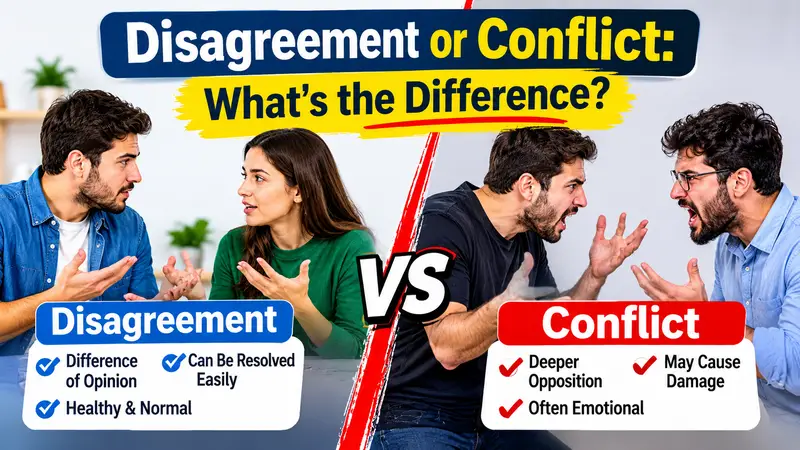
Disagreement and conflict both describe situations in which people, opinions, or interests do not match. However, they are not exactly the same. A disagreement usually involves different opinions or a failure to reach an agreement, while a conflict often involves a stronger or more active clash between people, groups, goals, or values.
Understanding the difference between disagreement or conflict can help you choose the right word in conversations, professional communication, academic writing, and everyday situations. Although a disagreement can develop into a conflict, the two words do not always describe the same level of tension.
Quick Answer
Disagreement means a difference of opinion between two or more people who do not agree about something. Conflict describes a more active or serious disagreement, struggle, or clash involving opposing interests, beliefs, needs, or goals. A disagreement does not necessarily create tension, but a conflict often involves greater difficulty or opposition.
What Does Disagreement Mean?
Disagreement is a noun that describes a situation in which people have different opinions, beliefs, ideas, or preferences. It happens when two or more individuals do not share the same view or cannot reach a common decision.
A disagreement does not automatically mean that people are angry or hostile toward each other. They can disagree respectfully while maintaining a positive relationship.
For example:
- My sister and I had a disagreement about our vacation plans.
- There is a disagreement among researchers about the results.
- The employees expressed disagreement with the new workplace policy.
- We had a small disagreement about where to eat dinner.
In these examples, people have different opinions, but the situation does not necessarily involve a serious argument or ongoing tension.
What Does Conflict Mean?
Conflict is a noun that describes a serious disagreement, struggle, or clash between individuals, groups, interests, or opposing ideas. It often involves tension, competing goals, or difficulty finding a solution.
Unlike an ordinary difference of opinion, conflict can affect relationships, teamwork, decision-making, and communication.
For example:
- The two coworkers experienced conflict over their responsibilities.
- The disagreement between the two departments developed into a workplace conflict.
- The country experienced a serious political conflict.
- She felt an internal conflict between her personal values and professional responsibilities.
Conflict also has meanings beyond interpersonal disagreements. It can describe armed fighting, competing priorities, or opposing forces in literature.
Disagreement vs. Conflict: Key Differences
Although these words are related, they differ in meaning, intensity, and usage.
| Feature | Disagreement | Conflict |
|---|---|---|
| Basic meaning | Difference of opinion | Serious clash or struggle |
| Intensity | Often mild or moderate | Often more serious |
| Emotional tension | Not always present | Frequently present |
| Main focus | Different views | Opposing interests or positions |
| Relationship impact | May have little effect | Can damage relationships |
| Resolution | Discussion or compromise | May require negotiation or mediation |
| Usage | Everyday and professional | Personal, social, political, and professional |
The most important distinction is that disagreement focuses on a lack of agreement, while conflict emphasizes an active clash or struggle.
However, context matters. A disagreement can be intense, and a conflict does not always involve shouting or anger.
Can a Disagreement Turn Into a Conflict?
Yes. A disagreement can develop into a conflict when people become increasingly unwilling to understand each other, when their interests directly oppose one another, or when the issue becomes emotionally charged.
Consider this example:
Stage 1: Disagreement
Two coworkers disagree about how to complete a project. One prefers to finish it quickly, while the other wants additional research.
Stage 2: Growing Tension
Neither employee accepts the other’s suggestion. They begin criticizing each other’s decisions.
Stage 3: Conflict
Their differences start affecting teamwork, communication, and project progress.
This example shows how a simple difference of opinion can develop into a more serious situation.
However, not every disagreement becomes a conflict. Respectful communication and compromise can prevent unnecessary tension.
Examples of Disagreement and Conflict in Everyday Life
Understanding these words becomes easier when you see how they work in different situations.
1. Family Relationships
Disagreement:
My parents and I had a disagreement about my weekend plans.
Conflict:
Ongoing conflict between the parents and their children created tension at home.
The first example describes different opinions, while the second suggests a more serious or continuing problem.
2. Workplace Situations
Disagreement:
The manager and employee had a disagreement about the project deadline.
Conflict:
The ongoing conflict between the manager and employee affected the entire team.
A workplace disagreement can be resolved through discussion. A continuing conflict may require management support or mediation.
3. Friendships
Disagreement:
My friend and I had a disagreement about which movie to watch.
Conflict:
Their personal conflict continued because neither person was willing to apologize.
A difference in preferences is usually a disagreement. A deeper clash involving emotions or unresolved issues may become a conflict.
4. Politics and Society
Disagreement:
There is considerable disagreement among voters about economic policies.
Conflict:
The political conflict between the opposing groups continued for several years.
Political disagreement can exist without violence. Political conflict may involve serious opposition, instability, or even armed fighting.
5. Personal Decisions
Disagreement:
There was a disagreement between the committee members about the proposal.
Conflict:
She experienced an internal conflict between accepting the promotion and spending more time with her family.
Here, conflict can describe an internal struggle rather than an argument between two people.
When Should You Use Disagreement?
Use disagreement when you want to describe different opinions, opposing viewpoints, or an inability to reach an agreement.
It is especially suitable when the situation is relatively calm or when you do not want to suggest a serious dispute.
Common expressions include:
- Have a disagreement
- Express disagreement
- Be in disagreement
- Disagreement about something
- Disagreement over an issue
- Disagreement between two people
Examples:
- The board members had a disagreement over the budget.
- I respectfully disagree with your opinion.
- There is considerable disagreement about the best solution.
In professional and academic writing, disagreement is often useful because it describes differences in opinion without automatically suggesting hostility.
When Should You Use Conflict?
Use conflict when describing a more serious clash involving opposing interests, beliefs, needs, responsibilities, or goals.
It is appropriate for personal relationships, workplace problems, political disputes, international situations, and literary analysis.
Common expressions include:
- Experience a conflict
- Resolve a conflict
- Avoid conflict
- Internal conflict
- Workplace conflict
- Conflict between two groups
- Conflict of interest
Examples:
- The company introduced a policy to reduce workplace conflict.
- The two organizations are in conflict over property rights.
- His personal beliefs conflicted with the company’s expectations.
Conflict is also used in formal and technical contexts, including psychology, law, business, and literature.
Common Mistakes to Avoid
1. Treating Every Disagreement as a Serious Conflict
Incorrect assumption: Every disagreement damages a relationship.
Better understanding: People can disagree without having a serious conflict. Respectful discussion is a normal part of healthy communication.
2. Using Disagreement for Every Type of Struggle
Less precise: She experienced a disagreement between her career goals and family responsibilities.
Better: She experienced a conflict between her career goals and family responsibilities.
Conflict is more natural when describing opposing needs or competing priorities within one person.
3. Assuming Conflict Always Means Violence
Conflict does not always involve physical fighting. It can describe emotional tension, opposing interests, workplace disputes, or internal struggles.
For example, a conflict between two coworkers may involve different approaches to a project rather than physical aggression.
4. Confusing Conflict With an Ordinary Difference of Opinion
A simple difference of opinion does not necessarily indicate a serious problem. Choose disagreement when the main point is that people have different views.
Related Words and Expressions
Several English words are closely related to disagreement and conflict.
- Argument: A discussion in which people express opposing views, often strongly.
- Dispute: A disagreement, often involving a specific issue or claim.
- Clash: A direct or noticeable opposition between people, ideas, or interests.
- Misunderstanding: A situation in which someone incorrectly understands another person’s words or intentions.
- Tension: A feeling of stress or strain between people or within a situation.
- Compromise: An agreement in which each side accepts some changes or gives up part of what it wants.
These words are not always interchangeable. The best choice depends on the situation and the level of opposition involved.
FAQs
Is disagreement the same as conflict?
No. Disagreement means people have different opinions or cannot reach an agreement. Conflict usually describes a more active or serious clash involving opposing interests, beliefs, or goals.
Can disagreement exist without conflict?
Yes. People can have different opinions without experiencing hostility or tension. Respectful communication allows individuals to disagree while maintaining positive relationships.
Is conflict stronger than disagreement?
Generally, yes. Conflict often suggests a more serious or active struggle, while disagreement can describe a simple difference of opinion. However, the exact intensity depends on context.
What is an example of disagreement turning into conflict?
Two employees may initially disagree about how to complete a project. If their differences lead to personal criticism, poor communication, and ongoing tension, the disagreement can develop into a workplace conflict.
Is disagreement a negative word?
Not necessarily. Disagreement is generally neutral and simply describes a difference of opinion. It can even encourage discussion, critical thinking, and better decisions.
What are the main types of conflict?
Common types include interpersonal conflict, workplace conflict, organizational conflict, political conflict, and internal conflict. Each describes a different kind of struggle or opposition.
Which word is more appropriate in professional writing?
Both words are appropriate, but they communicate different levels of seriousness. Use disagreement for differences of opinion and conflict for more serious clashes involving competing interests or ongoing tension.
Conclusion
Disagreement and conflict are closely related, but they describe different situations. A disagreement occurs when people have different opinions or cannot agree, while conflict generally involves a stronger clash between opposing interests, beliefs, or goals.
Remember the simplest distinction: a disagreement is a difference of opinion; a conflict is a struggle or clash that may develop from that difference. Choosing the correct word makes your English clearer, more accurate, and more natural.