
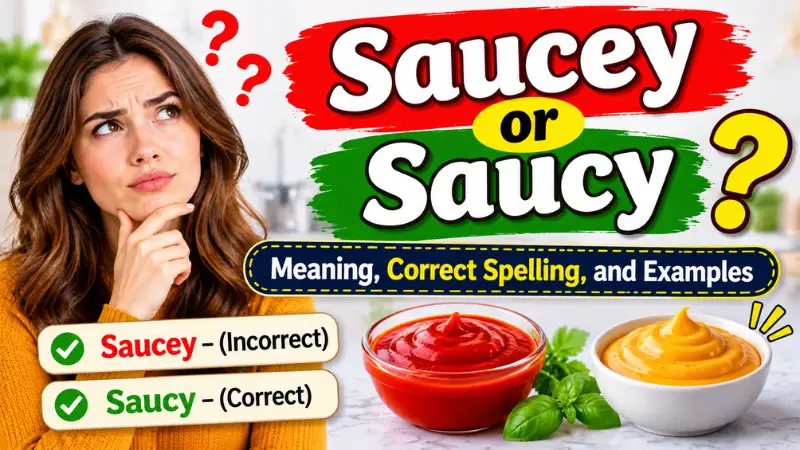
If you’re unsure whether to write saucey or saucy, the standard spelling in American English is saucy. It is an adjective that can describe food containing plenty of sauce or someone who is cheeky, bold, playful, or slightly disrespectful. Although saucey appears as an alternative spelling in some historical and informal contexts, it is not the usual spelling in modern standard writing.
The confusion is understandable because the original noun is sauce. However, the established adjective drops the final e to become saucy. Knowing this difference will help you spell the word correctly in recipes, conversations, school assignments, and professional writing.
Quick Answer: Saucey or Saucy?
Saucy is the standard and recommended spelling in American English. Use it to describe flavorful food with plenty of sauce or a person who behaves in a cheeky, confident, or playfully provocative way.
Saucey is an attested alternative form, but it is not the conventional spelling for everyday standard English. Unless it is part of a brand name or another proper name, choose saucy.
What Is the Difference Between Saucey and Saucy?
The main difference is standard spelling. Saucy is the established English adjective, while saucey is an alternative spelling that readers may encounter but should generally avoid in ordinary writing.
| Feature | Saucy | Saucey |
|---|---|---|
| Standard spelling | Yes | No |
| Dictionary-recognized adjective | Yes | Not the standard form |
| Describes food with sauce | Yes | Not recommended |
| Describes cheeky behavior | Yes | Not recommended |
| Appropriate for formal writing | Yes | Generally no |
| Possible use in names | Yes | Yes |
There is a small historical distinction worth understanding: saucey is recorded as an alternative form of saucy in some lexical references. Therefore, calling it completely nonexistent would be inaccurate. However, saucy remains the spelling to choose in contemporary standard American English. Oxford Learner’s Dictionaries+2
What Does Saucy Mean?
The adjective saucy has several meanings. Its interpretation depends on whether someone is describing food, a person’s behavior, or something humorous.
1. Saucy Means Full of Sauce
When describing food, saucy means containing plenty of sauce or having a consistency similar to sauce.
Examples:
- The restaurant serves delicious saucy chicken wings.
- I prefer saucy pasta over dry pasta.
- These barbecue ribs are tender and saucy.
- She prepared a saucy tomato dish for dinner.
This meaning is especially useful in recipes, restaurant reviews, and food descriptions.
2. Saucy Means Cheeky or Bold
When describing a person, expression, or comment, saucy can mean cheeky, impertinent, or playfully disrespectful.
For example:
- The little boy gave his teacher a saucy reply.
- She had a saucy smile on her face.
- His saucy attitude made everyone laugh.
- That was a rather saucy comment!
The word can suggest confidence and humor rather than serious disrespect. However, it can sound inappropriate when someone uses it toward a person who expects respectful or formal behavior.
3. Saucy Means Playfully Suggestive
Another meaning involves humor or language that makes a mild sexual suggestion.
Examples:
- They exchanged a few saucy jokes.
- The comedian included some saucy humor in the show.
- He sent her a saucy message.
This meaning is usually playful rather than explicitly offensive. Nevertheless, it may not be suitable for professional conversations or formal situations.
Oxford describes this sense in connection with humorous, mildly provocative language, while the American Heritage Dictionary also recognizes the food-related and cheeky meanings. Oxford Learner’s Dictionaries+2
Why Is Saucy Spelled Without the E?
The confusion comes from the original noun sauce.
It may seem logical to add y directly to the complete word:
– Sauce + y = Saucey
However, the established adjective is spelled:
– Sauce → Saucy
The final e is not retained in the standard form. Oxford traces the adjective to sauce + -y and identifies its development from an earlier food-related meaning. Oxford Learner’s Dictionaries+1
You can remember the spelling by comparing these familiar words:
| Original word | Correct adjective |
|---|---|
| Ice | Icy |
| Spice | Spicy |
| Juice | Juicy |
| Shine | Shiny |
| Sauce | Saucy |
These examples are useful spelling reminders, although the safest approach is to remember saucy as the established word rather than assume every English suffix follows an identical rule.
How to Use Saucy in American English
Saucy is an adjective, so it describes a noun. You can use it before a noun or after a linking verb.
Before a noun:
- She made a saucy remark.
- We ordered saucy chicken wings.
- He wore a saucy outfit.
After a linking verb:
- The pasta looks saucy.
- Her response was saucy.
- That joke sounds a little saucy.
The tone changes with the subject. When describing food, it is usually neutral and positive. When describing someone, it can suggest playful confidence, cheekiness, or suggestive humor.
Correct and Incorrect Examples
Here are practical examples showing which spelling to use.
| Incorrect | Correct |
|---|---|
| The pasta is saucey. | The pasta is saucy. |
| She made a saucey comment. | She made a saucy comment. |
| He gave me a saucey smile. | He gave me a saucy smile. |
| These wings are very saucey. | These wings are very saucy. |
| That was a saucey joke. | That was a saucy joke. |
For ordinary English writing, choose saucy in each example.
One exception is a proper name. If a company, product, username, or business intentionally uses the spelling Saucey, preserve its official spelling rather than correcting its name.
What Are the Comparative and Superlative Forms of Saucy?
Saucy has standard comparative and superlative forms:
| Form | Word | Example |
|---|---|---|
| Base form | Saucy | The chicken is saucy. |
| Comparative | Saucier | This chicken is saucier. |
| Superlative | Sauciest | These are the sauciest wings. |
Notice that the spelling changes from y to i when forming the comparative and superlative.
Examples:
- This pasta is saucier than yesterday’s meal.
- That restaurant serves the sauciest ribs in town.
- Her second response was even saucier than the first.
The correct forms are saucier and sauciest, not sauceier or sauceiest. Oxford also records these standard grammatical forms. Oxford Learner’s Dictionaries+1
Is Saucy Formal or Informal?
Saucy is an established English adjective, but its tone is usually conversational rather than strictly formal.
Its suitability depends on the context:
- Everyday conversation: Appropriate for playful comments and food descriptions.
- Food writing: Natural when describing dishes containing plenty of sauce.
- Friendly conversations: Suitable for describing cheeky humor or a playful attitude.
- Professional communication: Use carefully, particularly when describing someone’s behavior.
- Academic writing: Usually choose a more precise alternative, such as impertinent, playful, or sauce-covered, depending on the intended meaning.
It is not inherently a swear word or an insult. However, calling someone saucy can sound disrespectful or suggestive depending on the relationship and situation.
FAQs
1. Is it saucey or saucy?
Saucy is the standard spelling in American English. Saucey is an alternative form that appears in some contexts, but it is not recommended for ordinary standard writing.
2. Is saucey a real word?
Saucey is recorded as an alternative spelling of saucy in some references. However, saucy is the established spelling used in modern standard English.
3. What does saucy mean in slang?
In informal conversation, saucy can describe someone who is cheeky, bold, playful, or slightly suggestive. It can also describe a humorous comment that pushes social boundaries without being seriously offensive.
4. Does saucy mean spicy?
Not exactly. Saucy usually describes food containing plenty of sauce, while spicy describes food with a strong spice flavor or heat. A dish can be both saucy and spicy, but the words have different meanings.
5. How do you pronounce saucy?
Saucy has two syllables and is pronounced approximately SAW-see or SAH-see, depending on the American accent. The standard spelling remains the same regardless of pronunciation.
6. What is the plural of saucy?
Saucy is an adjective, so it does not have a regular plural form. It changes according to comparison instead: saucy, saucier, and sauciest.
7. Can I use saucey as a brand name?
Yes. Businesses, products, and creative projects can intentionally use Saucey as a name. Proper names retain their chosen spelling, even when it differs from conventional English spelling.
Conclusion
When choosing between saucey or saucy, use saucy for standard American English writing. It describes food containing plenty of sauce, a cheeky personality, a bold remark, or playful suggestive humor.
Although saucey appears as an alternative spelling in some references, it is not the conventional choice for everyday writing. Remember the standard form, sauce → saucy, and use saucier and sauciest when making comparisons.