
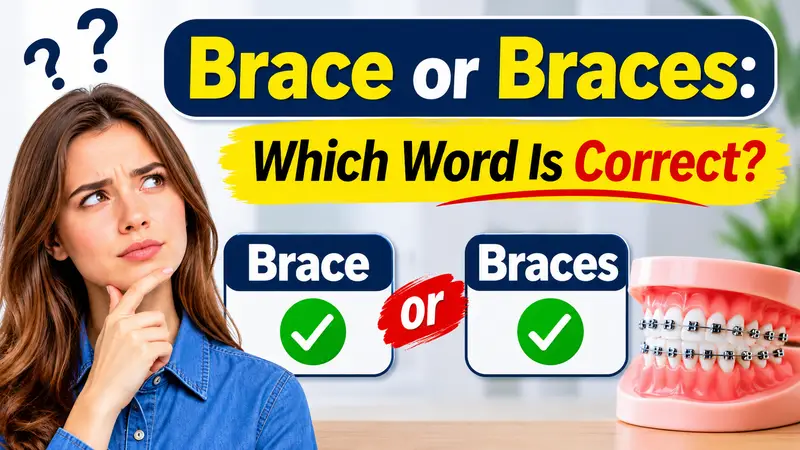
Brace or Braces: Which Word Is Correct?
Brace and braces are both correct English words, but they are not always interchangeable. The difference usually depends on whether you are talking about one support device, multiple supports, or a particular item that traditionally takes a plural form.
In American English, brace generally refers to one supporting device, such as a knee brace or back brace. Braces, however, is the standard word for the orthodontic appliance worn on teeth. Understanding this distinction will help you choose the right word in everyday conversations, medical situations, and writing.
Quick Answer
Brace is the singular noun, and braces is its regular plural form. For example, one knee support is a brace, while two knee supports are braces. However, in American English, the metal or clear appliance used to straighten teeth is normally called braces, even when referring to one complete appliance.
What Does Brace Mean?
A brace is a device or structure that supports, strengthens, holds, or stabilizes something.
It is commonly used when discussing medical supports, construction, and physical protection.
For example:
- She wears a knee brace while playing tennis.
- The doctor recommended a back brace.
- The carpenter installed a wooden brace to strengthen the wall.
- He wore a neck brace after the accident.
As a noun, brace refers to one supporting object.
Brace can also function as a verb. To brace means to prepare yourself for something difficult or to support something so that it stays steady.
Examples:
- Brace yourself for the unexpected news.
- He braced his hands against the wall.
What Does Braces Mean?
Braces has several meanings, depending on the context.
1. Dental Braces
In American English, braces are devices attached to the teeth to gradually move them into better alignment.
Examples:
- My daughter needs braces.
- I wore braces when I was younger.
- The orthodontist adjusted my braces yesterday.
Although braces looks plural, it normally refers to the complete dental appliance, not necessarily multiple separate devices.
2. More Than One Support
Braces is also the regular plural of brace when discussing separate supporting devices.
Examples:
- The athlete uses two knee braces.
- Workers installed additional braces to strengthen the structure.
- The patient ordered new leg braces.
3. Curly Braces in Writing
In mathematics, programming, and writing, braces can refer to the curly symbols .
Example:
{apple, banana, orange}
These symbols are called curly braces or brace symbols.
4. Clothing Meaning
In British English, braces can refer to straps worn over the shoulders to hold up trousers.
In American English, these are generally called suspenders.
Brace vs. Braces: Main Differences
| Feature | Brace | Braces |
|---|---|---|
| Grammatical form | Singular | Plural |
| Main meaning | One supporting device | Multiple supports |
| Dental usage in US | Not normally used | Standard term |
| Medical example | Knee brace | Leg braces |
| Writing symbols | One brace symbol | Both curly braces |
| Pronunciation | Brays | BRAY-siz |
The important point is that braces is not always simply a reference to multiple physical objects. Its dental meaning is conventionally plural in American English.
When Should You Use Brace or Braces?
Choose the word according to the meaning you want to communicate.
Use brace when:
- Referring to one knee support.
- Talking about one back support.
- Describing one structural support.
- Using brace as a verb.
Examples:
- I bought a new wrist brace.
- The doctor suggested a neck brace.
- We need a stronger wooden brace.
Use braces when:
- Referring to orthodontic treatment in American English.
- Talking about more than one supporting device.
- Referring to the pair of curly symbols in writing.
Examples:
- She is getting braces next month.
- He wears braces on both legs.
- Add curly braces around the code block.
Common Mistakes to Avoid
Mistake 1: Using Brace for Dental Treatment in American English
Incorrect: She is getting a brace next week.
Better: She is getting braces next week.
In American English, braces is the conventional term for the orthodontic appliance.
Mistake 2: Using Braces for One Ordinary Support
Incorrect: He bought a braces for his injured knee.
Better: He bought a brace for his injured knee.
A single knee support is called a brace.
Mistake 3: Forgetting the Plural Verb
Incorrect: Her braces is uncomfortable.
Better: Her braces are uncomfortable.
Braces takes a plural verb in standard American English.
Mistake 4: Confusing Braces With Brackets
Braces and brackets are different punctuation marks.
- Braces:
- Square brackets: [ ]
- Parentheses: ( )
Using the correct name helps avoid confusion, especially in mathematics and programming.
Is Brace Singular or Plural?
Brace is normally a singular countable noun. Its regular plural form is braces.
Examples:
- One brace supports the injured knee.
- Two braces support both knees.
There is also a less common special use in which brace means a pair of things, particularly two hunted birds or animals. In that meaning, the plural can remain brace, as in “two brace of pheasants.” English meaning – Cambridge Dictionary+1
Is Braces Singular or Plural?
Braces is grammatically plural in its ordinary uses.
However, when referring to dental treatment, it describes one complete orthodontic appliance in American English.
For example:
- My braces are new.
- His braces look different.
- I need to get braces.
Although one person wears one complete set, the established expression is still braces are, not brace is.
Frequently Asked Questions
1. Is it brace or braces for teeth?
In American English, braces is the correct and standard term for the orthodontic appliance used to straighten teeth. For example, “I need braces” is natural American English.
FAQs
1. Is it brace or braces for teeth?
In American English, braces is the correct and standard term for the orthodontic appliance used to straighten teeth. For example, “I need braces” is natural American English.
2. Is brace the singular of braces?
Yes. Brace is generally the singular form, and braces is its regular plural. However, dental braces are conventionally referred to using the plural form in American English.
3. Should I say my brace is or my braces are?
Use “my brace is” when referring to one ordinary support device. Use “my braces are” when talking about your dental appliance or multiple supporting devices.
4. What is the difference between a knee brace and knee braces?
A knee brace refers to one supporting device. Knee braces refers to more than one device, although the exact number depends on the context.
5. Are braces and brackets the same?
No. Braces are curly symbols , while brackets usually refer to square symbols [ ] in American English. They serve different purposes in writing and mathematics.
6. Is braces American or British English?
Both varieties use the word braces, but its meaning can differ. Americans commonly use braces for dental appliances, while British English also uses braces for suspenders.
7. Can brace be used as a verb?
Yes. Brace can mean to prepare yourself for something difficult or to support something physically. For example, “Brace yourself for the cold weather.
Conclusion
Brace and braces are both correct, but their usage depends on context and grammatical number. Use brace for one ordinary supporting device and braces for multiple supports. When discussing orthodontic treatment in American English, use braces, even when referring to one complete dental appliance.
Remembering these distinctions will help you write naturally and avoid common singular-versus-plural mistakes.