
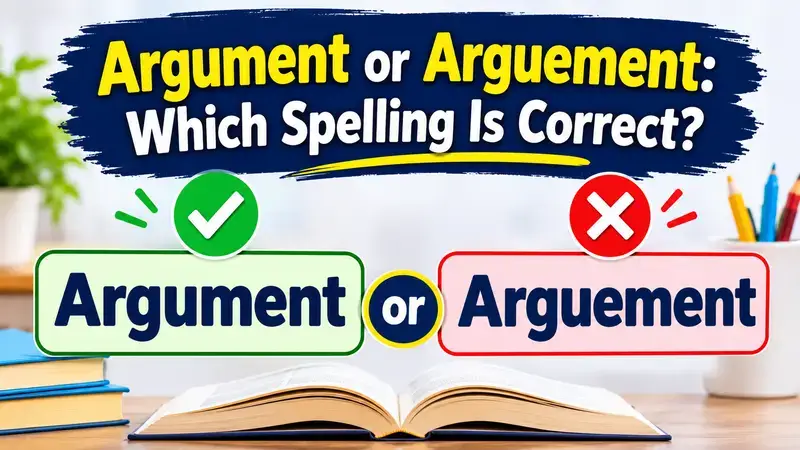
If you have ever wondered whether to write argument or arguement, the correct spelling is argument. The spelling arguement is a common mistake in English, not the standard form used in American writing.
The confusion usually happens because the verb argue ends in an e, making it tempting to keep that letter when forming the noun. However, the established spelling drops the final e: argue becomes argument. Whether you are writing an essay, sending an email, or describing a disagreement, using the correct spelling helps keep your writing clear and professional.
Quick Answer
Argument is the correct spelling in American English. Arguement is a misspelling and should not be used in standard writing. An argument can mean a reason supporting an opinion, a discussion involving disagreement, or a formal presentation of reasons and evidence. Remember to write it without an extra e.
Argument vs. Arguement: Spelling Comparison
| Spelling | Status | Explanation |
|---|---|---|
| Argument | Correct | Standard English spelling |
| Arguement | Incorrect | Common misspelling |
The difference is one extra letter. The incorrect version includes an e between the u and m, while the correct version does not.
Correct: argument
Incorrect: arguement
For example:
- Correct: She presented a convincing argument during the meeting.
- Incorrect: She presented a convincing arguement during the meeting.
Always use argument in standard American English.
What Does Argument Mean?
Argument is a noun that describes a reason or set of reasons used to support or challenge an idea, opinion, or position. It can also refer to a disagreement between two or more people.
The meaning depends on the situation.
1. Argument as a Reason or Explanation
An argument can be a logical explanation supported by facts, examples, or evidence. People use arguments in academic writing, discussions, debates, and professional settings.
Examples:
- Her argument convinced the committee to reconsider its decision.
- The student supported his argument with reliable research.
- A strong argument should include clear evidence.
In this context, an argument does not necessarily involve anger or conflict. It is simply a structured way of presenting reasons.
2. Argument as a Disagreement
An argument can also describe a verbal disagreement between people who have different opinions.
Examples:
- My brother and I had an argument about money.
- Their argument became louder as the discussion continued.
- She apologized after having an argument with her friend.
In everyday conversation, this is one of the most familiar meanings of the word.
3. Argument in Academic and Professional Writing
In essays, research papers, and professional discussions, an argument is the main position someone wants to establish.
Examples:
- The writer develops an argument about climate change.
- The report presents a strong argument for improving public transportation.
- The lawyer made an argument based on the available evidence.
Here, the word usually refers to reasoning rather than a personal fight.
Why Is Argument Spelled Without an E?
The confusion comes from the relationship between argue and argument.
The verb argue ends in the letter e, but its noun form is spelled argument, without that final e.
| Word | Correct spelling |
|---|---|
| Verb | Argue |
| Noun | Argument |
| Adjective | Argumentative |
| Noun | Argumentation |
| Verb form (-ing) | Arguing |
| Verb form (-ed) | Argued |
The important point is that English spelling does not always follow one simple suffix rule. Although many words retain their final e before a consonant-based ending, argument is an established exception.
Cambridge’s English Grammar Today specifically gives the spelling change:
- Argue → Argument
- Argue → Arguing
Therefore, writing arguement because the original verb contains an e is a spelling mistake.
How to Remember the Correct Spelling
If you frequently confuse the two spellings, these simple techniques can help.
1. Remember the missing E
Think of the correct word as:
ARGU + MENT = ARGUMENT
There is no extra e between u and m.
2. Learn the word family
Remember these related forms:
- Argue
- Argument
- Arguing
- Argued
- Argumentative
Seeing the correct forms together makes the spelling easier to recognize.
3. Use a sentence for practice
Write this sentence several times:
“Every strong argument needs a clear reason.”
Practicing a complete sentence can help you remember the spelling in context.
Examples of Argument in Everyday English
Here are some natural examples showing how to use the correct spelling in different situations.
Everyday conversations
- We had an argument about where to spend the weekend.
- Their argument started over a small misunderstanding.
- I do not want another argument about the same issue.
School and academic writing
- The essay presents a clear argument.
- Students must support their arguments with evidence.
- Her argument was logical and easy to understand.
Workplace communication
- The manager made a strong argument for changing the schedule.
- His argument helped the team understand the problem.
- We discussed the argument before making a final decision.
Formal discussions
- The attorney presented an argument before the court.
- The researchers developed an argument based on their findings.
- Each speaker explained an argument supporting their position.
Notice that argument works naturally in both casual and formal situations.
Common Mistakes to Avoid
Even though the spelling difference is small, several mistakes can appear in everyday writing.
| Incorrect | Correct |
|---|---|
| Arguement | Argument |
| Arguements | Arguments |
| Arguementative | Argumentative |
| Arguementation | Argumentation |
One important detail is that the plural form is arguments, not arguements.
Also, do not confuse the noun argument with the verb argue.
- Correct: They argue about politics.
- Correct: They had an argument about politics.
- Incorrect: They had an arguement about politics.
Use argue when describing the action and argument when referring to the disagreement or reasoning.
FAQs
1. Is it argument or arguement?
Argument is the correct spelling. Arguement is a common misspelling that adds an unnecessary e. Use argument in essays, emails, professional documents, and everyday writing.
2. Why is argument spelled without an e?
Although the verb argue ends in e, the established noun spelling drops that letter. The correct form is argument, not arguement. It is a spelling exception worth memorizing.
3. Is arguement ever correct in English?
Arguement is recorded as an obsolete form in some historical references, but it is not the accepted spelling for modern standard English writing. Treat it as a misspelling unless you are reproducing an original historical text.
4. What is the plural of argument?
The plural of argument is arguments. For example: “The students presented several arguments during the discussion.”
5. Is argument a noun or a verb?
Argument is a noun. The related verb is argue. For example, “They argue frequently” uses the verb, while “They had an argument” uses the noun.
6. What is the difference between an argument and a disagreement?
An argument can describe a disagreement, but it can also mean a logical explanation supporting an idea. A disagreement simply means that people have different opinions. The context determines which meaning is intended.
7. Is argument spelled the same way in British and American English?
Yes. Argument is the standard spelling in both American and British English. There is no standard American spelling difference between these two forms.
Conclusion
When choosing between argument and arguement, always use argument. The second spelling contains an unnecessary e and is not accepted in modern standard American English.
Remember that argue becomes argument, not arguement. Whether you are discussing a disagreement, writing an academic essay, or presenting evidence at work, the correct spelling is always argument.