SEO Title
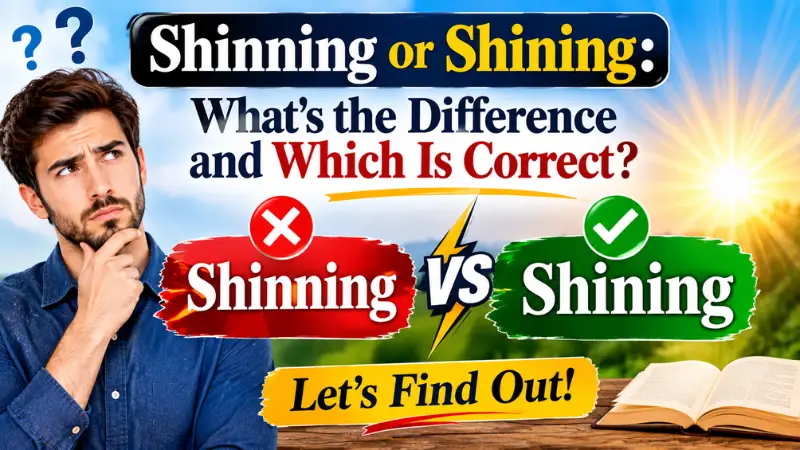
Shinning or Shining: Which Spelling Is Correct?
URL Slugshinning-or-shining
Meta Description
Shinning or shining? Learn the correct spelling, meanings, grammar rules, and examples to understand when to use each word in American English.
Featured Image Prompt
Create a professional 800 × 450 educational English grammar illustration comparing “SHINNING” and “SHINING.” Show the correct spelling “SHINING” with a bright glowing sun, sparkling light, and a polished golden surface. Show “SHINNING” as a separate, less prominent spelling with a subtle climbing illustration. Clean modern typography, balanced layout, white and soft blue background, professional language-learning blog aesthetic, high resolution.
Image Alt Text
Educational spelling comparison showing the words shinning and shining with examples of their different meanings.
Shinning or Shining: What’s the Difference and Which Is Correct?
Choosing between shinning and shining can be confusing because both are real English words, but they have different meanings. The correct spelling depends on what you want to express.
If you are talking about something giving off light, looking bright, or appearing impressive, shining is the correct spelling. For example, you might say, “The sun is shining today.”
However, shinning is also a legitimate word. It is the present participle of shin, a verb that means climbing something by gripping it with your arms and legs. Understanding this difference will help you choose the right spelling in everyday American English.
Quick Answer
Shining is the correct spelling when describing something that glows, gives off light, reflects brightness, or performs exceptionally well. Shinning is also correct, but it refers to climbing something, usually a pole or tree, by gripping it with your arms and legs. For brightness, use shining, not shinning.
Why Is “Shining” the Correct Spelling for Brightness?
The word shining comes from the verb shine. When you add the suffix -ing to shine, you remove the final silent e and add -ing.
The spelling follows this pattern:
- Shine → Shining
- Smile → Smiling
- Write → Writing
- Drive → Driving
The final e disappears because of a common English spelling rule for verbs ending in a silent e.
What Does Shining Mean?
Shining describes something that:
- Produces or reflects light.
- Looks bright, polished, or glossy.
- Shows excellence or outstanding ability.
- Appears radiant or impressive.
Examples:
- The stars are shining brightly tonight.
- She polished her shoes until they were shining.
- He is a shining example of honesty.
- The sunlight was shining through the window.
- Her talent is shining in the school competition.
In everyday American English, shining is common in both literal and figurative expressions.
What Does Shinning Mean?
Shinning is the present participle of the verb shin. It describes climbing up, down, or along an object by gripping it with your hands and legs.
For example:
- The boy is shinning up the tree.
- The workers were shinning up the poles.
- He started shinning down the drainpipe.
Although shinning is a valid English spelling, it is much less common than shining in everyday writing.
In North American English, shinny is another form of the climbing verb. The exact choice depends on the dictionary and usage context.
Shinning vs. Shining: Key Differences
| Feature | Shining | Shinning |
|---|---|---|
| Root verb | Shine | Shin |
| Meaning | Giving or reflecting light | Climbing by gripping |
| Part of speech | Verb form; also adjective | Verb form |
| Common use | Everyday English | Uncommon climbing context |
| Example | The sun is shining. | He is shinning up a tree. |
The important distinction is the root word. Shining comes from shine, while shinning comes from shin.
When Should You Use Shining?
Use shining whenever you describe light, brightness, reflection, or excellence.
Here are some common situations:
1. Describing sunlight or natural light
- The sun is shining over the mountains.
- The moon was shining through the clouds.
2. Describing polished objects
- My new shoes are shining.
- The shining silver looked beautiful on the table.
3. Describing someone’s achievements
- She has a shining career in medicine.
- His performance was a shining example of teamwork.
4. Describing someone’s appearance
- Her eyes were shining with excitement.
- The children had shining smiles.
Common Spelling Mistakes to Avoid
The most common mistake is writing shinning when you mean something is bright or producing light.
Incorrect: The sun is shinning today.
Correct: The sun is shining today.
Incorrect: Her shoes are shinning after polishing.
Correct: Her shoes are shining after polishing.
Incorrect: The stars are shinning in the sky.
Correct: The stars are shining in the sky.
These corrections apply when the intended meaning involves brightness. If someone is climbing a pole or tree, shinning can be correct.
Easy Trick to Remember the Correct Spelling
Remember the root word:
- SHINE + ING = SHINING: Think of sunlight, stars, brightness, and polished objects.
- SHIN + ING = SHINNING: Think of climbing a tree, pole, or similar object.
If you are writing about light, remember that shine loses its final silent e before adding -ing.
Frequently Asked Questions
1. Is it shining or shinning?
Both spellings are correct, but they have different meanings. Shining describes something bright or giving off light, while shinning describes climbing by gripping an object with your hands and legs.
2. Why is shining spelled with one N?
Shining comes from shine. When a verb ends in a silent e, that final letter is usually removed before adding -ing. Therefore, the correct spelling is shining, not shinning.
3. Is shinning a real English word?
Yes. Shinning is a legitimate English word and the present participle of shin. It describes climbing something, such as a tree or pole, by holding it with your arms and legs. English meaning – Cambridge Dictionary+1
4. Is shining an adjective or a verb?
Shining can function as both a verb form and an adjective. For example, “The stars are shining” uses it as part of a verb phrase, while “a shining star” uses it as an adjective.
5. What is the past tense of shine?
The past tense of shine can be either shone or shined, depending on the meaning and context. For example, “The sun shone brightly” and “She shined her shoes” are both correct.
6. Is shinning the same as shinnying?
They are related forms of the climbing verb. Shinning is the -ing form of shin, while shinnying is the -ing form of shinny. Both can describe climbing by gripping an object. English meaning – Cambridge Dictionary+2
Conclusion
The choice between shinning or shining depends on what you want to say. Use shining when describing light, brightness, polished surfaces, or exceptional qualities. Use shinning when referring to climbing something by gripping it with your hands and legs.
For everyday American English, shining is the spelling you will usually need when talking about something bright or radiant. Remembering the original verb, shine, makes the correct spelling easy to recognize.
>>